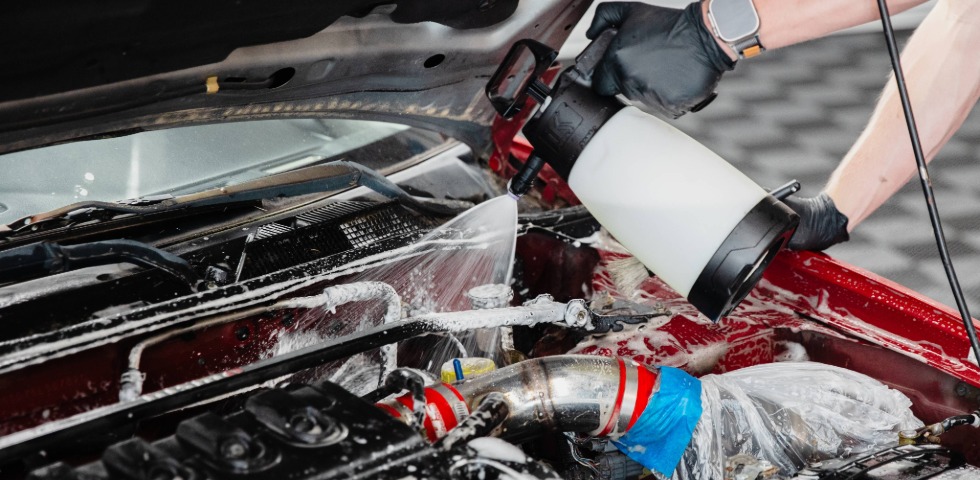

Engine bays are one of the last areas where product choice still gets overlooked in professional detailing. Most of what you’re dealing with under the hood is not heavy grease buildup, it’s a mix of road film, light oils, dust, and heat-cycled contamination sitting on a variety of substrates. Plastics, coated metals, rubber, and painted components all react differently, which is why a one-dimensional degreaser is rarely the right tool.


This is where a balanced multi purpose cleaner like Gtechniq W2 becomes more efficient than a traditional aggressive APC or degreaser.
W2 is a solvent-assisted alkaline cleaner, which is important to understand from a performance standpoint. The inclusion of solvents like 2-butoxyethanol allows it to break down oily residues and traffic film, while alkaline builders such as disodium metasilicate help lift and suspend inorganic contamination . That combination gives you a broader cleaning spectrum without needing excessive alkalinity or harsh caustic behavior.
In practice, that means you’re not relying on brute force chemistry. You’re using a system that dissolves and lifts contamination efficiently, which is exactly what you want in an engine bay where material safety matters just as much as cleaning power.
Another advantage of W2 is dilution control. Engine bays vary significantly in contamination levels. A lightly used vehicle with dust and light grime requires a completely different approach than something that has seen years of neglect. Being able to scale the strength of W2 allows you to match the chemistry to the job instead of defaulting to maximum strength every time.
From a process standpoint, efficiency comes down to dwell and mechanical assistance.
A properly diluted W2 should be applied to a cool engine and allowed to dwell long enough for the solvents and alkaline components to break down the contamination. This reduces the need for aggressive brushing. When agitation is required, it should be targeted and controlled, focusing on seams, textured plastics, and areas where buildup accumulates.
The key difference you’ll notice using a product like W2 is how the contamination releases from the surface. Instead of smearing or requiring repeated passes, it lifts and rinses cleanly. That rinse behavior is critical. A cleaner that leaves behind residue or partially emulsified oils creates more work and can negatively affect the finish of plastics and trim.
Material compatibility is another reason to avoid overly aggressive degreasers. High alkalinity products can stain or prematurely age plastics and rubber, especially in an environment that already sees constant heat cycling. W2 sits in a range where it is effective but still controlled, which makes it better suited for modern engine bays.
From a workflow perspective, incorporating engine bay cleaning into regular maintenance changes the approach entirely. Instead of correcting years of buildup, you are maintaining a surface that never reaches that point. At that stage, lighter dilutions and minimal agitation are all that’s required, which improves efficiency and consistency across jobs.
At a professional level, engine bay cleaning is less about making it look good once and more about developing a repeatable process that is safe, efficient, and scalable. Product selection plays a major role in that, and understanding the chemistry behind what you’re using is what separates a routine clean from a controlled, professional result.
If you’re regularly doing engine bays, what dilution ratios and processes have you found most efficient?
Related Posts
- Different Uses For Detailing Products
- Rag Company Rip N’ Rags vs Autofiber Roll-o-Rags
- Unlocking the Plant Power of Oberk APS : A Comprehensive Guide Of The Ultimate Organic Soap For Professionals and DIY enthusiasts
- All About Microfiber Featuring Autofiber!
- Projects: 1977 Porsche 911S RSR Tribute Detail