

Clay Bar & Clay Alternatives Detailing Guide
by Reece @ DI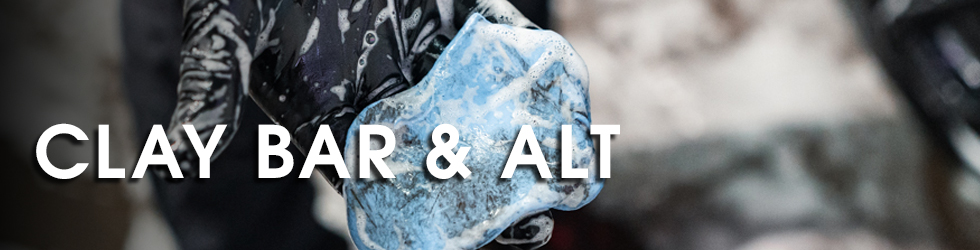
After the washing and decontamination steps, you can still be left with embedded contamination on exterior surfaces of your vehicle. This is where clay bars and clay alternatives come into play. These tools are designed to safely pull these embedded particles from the surface of your paint, leaving it smooth and ready for polishing or protection. Not only can you clay your vehicles paint, but glass, wheels, lights and more.
Grab Your Gear!
Clay Bar and Clay Alternatives. What are They?
The traditional clay bar has been a detailing staple for decades. Made from a pliable synthetic resin, clay bars are used with a lubricant to glide across the surface, gently pulling away embedded contaminants from the surface. When properly used, a clay bar can restore an ultra-smooth finish ready for your polishing and protection steps.
Clay alternatives, such as clay mitts, towels, and pads, offer a modern take on the traditional clay bar. These products feature a rubberized polymer material that mimics the decontamination effect of clay while offering several advantages.
- Reusable
- Easier to Clean
- Increased Durability
The efficiency and long-term value make it easy to prefer clay alternatives, especially when working on multiple vehicles. Despite their benefits, they can be more aggressive and prone to marring, so proper lubrication and light pressure remain key to best results.
What are Clay Lubricants and Why are They Important?
No matter which clay bar or clay alternative you choose, lubrication is essential. A quality clay lubricant reduces friction between the surface and the clay or clay alternative, allowing contaminants to lift away cleanly without marring the surface. Dedicated clay lubes are typically formulated for optimal glide and residue free performance, though detail sprays and rinseless wash products can sometimes double as lubricants in a pinch.
For clay alternatives, a proper clay lubricant becomes even more important due to the increased surface contact and potential aggressiveness of the polymerized material they are made of. The right lubricant ensures smooth gliding and minimized risk of marring during use. These options also can react to different chemicals in a negative way, causing these surfaces to become extremely sticky and leaving residue and marring on the surface. Proper clay lubes will avoid any of these negative reactions, allowing you to use your clay alternative for a long time.
Simply put, using the right lubricant ensures both your paint and your clay media remain in top condition throughout the process.
How to Use a Clay Bar
- Wash and dry your vehicle
- Break off a small piece of clay that you will be working with and shape it into a flat shape.
- Working in a small section, mist the clay lubricant over your working area.
- Gently glide the clay bar with light pressure over your working area using overlapping passes.
- Continue working on an area until all contamination is removed. You can tell this has happened because the clay will slide effortlessly across the paint and you will not feel any contamination being picked up by the clay.
- Wipe off the excess clay lube with a microfiber towel.
- Continue over the entire surface of the vehicle.
How to Use Clay Alternatives
- Wash and dry your vehicle
- If necessary, use a clay bar to remove really stubborn contamination such as tree sap and tar. Clay bars may work better for this and will prolong the life of your decon pads or towels.
- Once the car is prepped, simply work section by section or panel by panel, spraying the lube liberally and lightly wiping with the pad or towel back and forth removing contaminants. If the pad skips or feels dry use more lube.
- When you are done with each section wipe away excess lube with a clean microfiber towel.
- Depending on the amount of contamination, it is a good idea to rinse the pad or towel under running water or in a bucket every 1-3 panels so the surface is clean.
- Continue over the entire surface of the vehicle.
Pro Tips
- Reshape your piece of clay after each section so that there is a clean fresh surface exposed. If you cannot reveal a fresh surface, break off a new piece of clay.
- Working on a small area ensures that your clay lube will not dry up too fast.
- To increase the life of your clay bar, spray the bar with a clay lube and store it in a clay bar storage container.
- If you drop a piece of clay, it must be discarded as picking up debris can cause damage to the paint during use.
- When choosing a clay bar, Fine Grades are great for light to moderately contaminated surfaces, while Medium Grades are better for heavily contamination surfaces.
- You do not want to rely on a lot of downward force when using a clay bar or clay alternatives. You should allow the clay to absorb the contamination and stubborn contamination can require a good amount of time, clay lube and passes to remove.
- Avoid using a clay bar in direct sunlight and on a hot surface. Heat can cause the clay lube to evaporate quickly.
- Once the entire car is decontaminated, you can give it a final rinse and dry if you want to be extra thorough. If you were already wiping away excess lube carefully and thoroughly you can be done. Sometimes however there’s just too much contamination that it’s better to simply give it a final wash and dry.
- Clay and clay alternatives not only work well on your paint, but also your glass, wheels, plastics, etc.
Related Articles
- How to Properly Use a Clay Bar
- The Importance of a Quality Clay Lube
- Why Claying is Vital
- Ask DI: Should I Use a Traditional Clay Bar or a Clay Alternative?
- When to “Clay” Your Car
- Effortless Paint Decontamination with NanoSkin Glide & AutoScrub Sponge
- How-To Clay Bar Video
- What Grade Clay Bar Should I Use?
- Ask DI: What are Clay Bar Alternatives?
- What are the Best Clay Bar Alternatives?
- 5 Clay Bar Tips





No comments yet. Be the first!