

How To Properly Wash and Dry a Car
by Todd CooperiderWithout Causing Swirls.
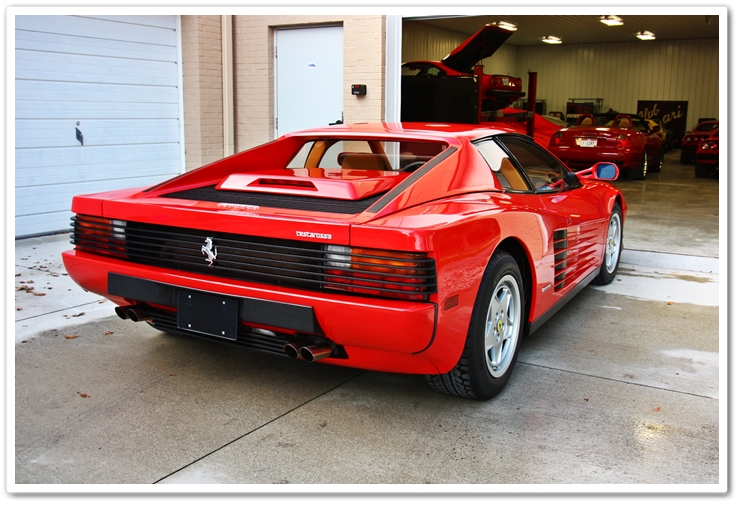
We all enjoy the feeling of driving a freshly washed car. The cleanliness of the vehicles we drive says a lot about the type of person we are. It’s no different than how we care for our houses, our landscaping, or our personal appearances. Beautifully prepared cars project confidence, professionalism, and just makes us feel good when driving (or admiring) them! And the act of car washing can be therapeutic and relaxing as well.
But as we engage in the ritualistic weekend activity, are we doing more damage than good? Although most car owners have spent countless hours over the years washing their vehicles, chances are it is being done incorrectly and/or with the improper materials which in the long run results in paint that is full of swirls. Not only do they make the paint look bad, but they also reduce the overall value of the car as well.
What are swirls and what causes them?
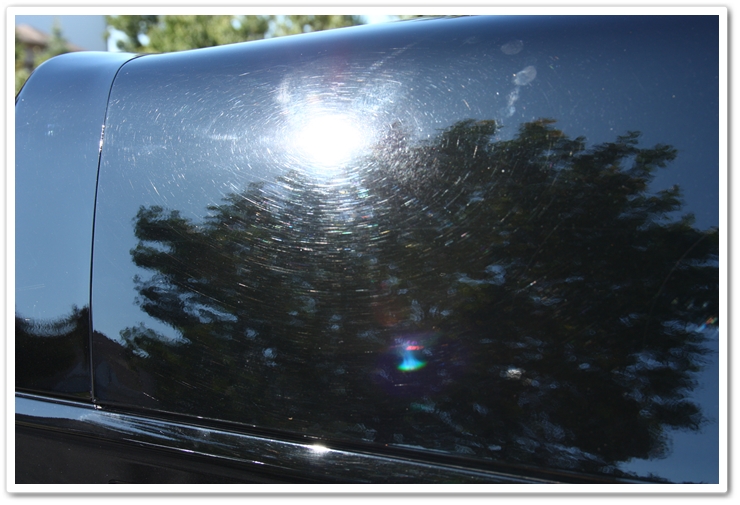
Swirls or spider webs on the surface of the car are thousands of micro-scratches that have a negative impact on the overall appearance. They are more noticeable on darker colored vehicles, and can easily be seen in direct sunlight or under the lights at night while in a parking lot.
While there are many causes of swirls, the biggest culprit is improper washing and drying techniques. They can be avoided for the most part once you learn how to properly wash and dry a vehicle, as well as which materials to use. One trip to the automatic car wash (also referred to as swirl-o-matics), or a quick wipe down with the wrong kind of towel can quickly destroy 15 hours of machine polishing. Even if the local car wash or dealership offers a hand-wash, it doesn’t mean that they are using proper methods or materials, and in many cases can do more harm than good.
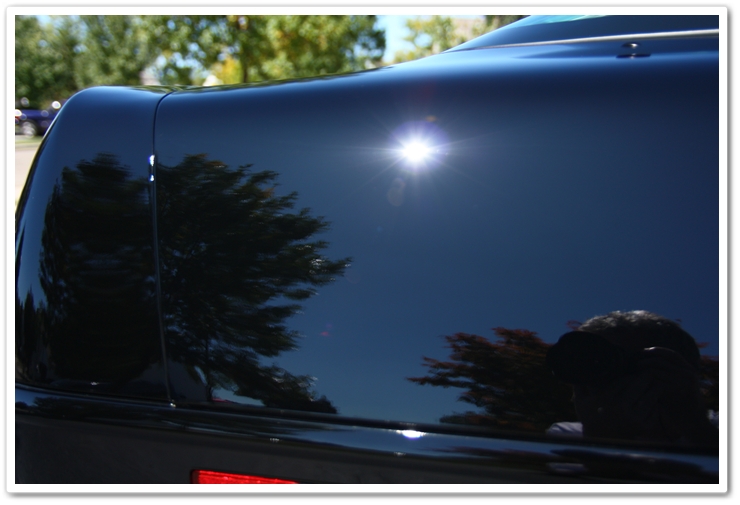
This is what paint should look like.
This is what it looks like after years of improper care.
What materials and products are needed?
My first advice is to say that you should keep your kitchen supplies where they belong…in the kitchen! Kitchen towels (or any household towels or rags) are very abrasive and easily scratch the delicate painted surfaces of your car. Dish soap over time can damage rubber trim, and it can strip off any wax from the finish as well.
You’ll need:
- At least 2, but preferably 3 buckets (they’re inexpensive, and stack to save space)
- At least 2, but preferably 4 Grit Guards
- A Waffle Weave microfiber towel for drying, and a supply of various plush microfiber towels for final buffing.
- A mild auto washing detergent.
- A plush sheepskin wash mitt (it’s always good to have a spare!)
- EZ Detail brushes for cleaning wheels and wheel wells
- A quick detailer spray and/or spray wax.
- A mild degreaser/all-purpose cleaner to help break down heavily soiled areas such as bird droppings, tar, sap, or other stubborn forms of contamination.
Let’s get started!
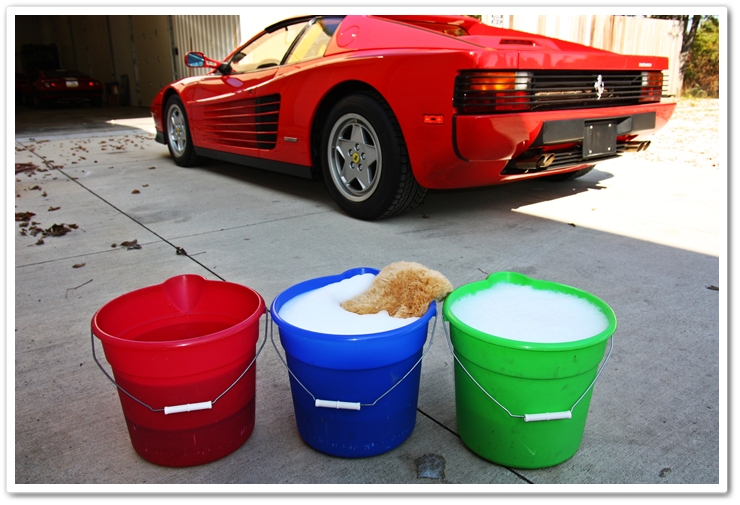
Now you’re ready to prepare your wash buckets. Yes, that was plural, as in more than one bucket! Ultimately you want 3 buckets. One is your wash bucket, one is your rinse bucket, and one is dedicated for wheel cleaning. You could get away with just two, but then you’d have to stop and clean out a bucket after you finish your wheels before you started on the rest of the car. Notice too that I use Grit Guards in both my rinse bucket and my wash bucket (for best results, use two Grit Guards per bucket!). For the rinse bucket in particular, this helps dislodge dirt and debris from the wash mitt, and then keeps the abrasive sediment at the bottom where it is away from the cleaner water at the top. The reason you need a rinse bucket is because you want the water in your wash bucket to remain clean throughout the entire process. If you use just one bucket that means you’re introducing dirt into your wash water, then using that same dirt to wash your car with…hence all the swirls!
Note: When you add your car wash detergent to your wash bucket, be sure to closely follow the manufacturer’s recommendation for how much product to use. More isn’t always better, and in fact you may strip any existing coats of wax by using too much detergent.
Grit Guards are placed at the bottom of both the wash and rinse buckets.
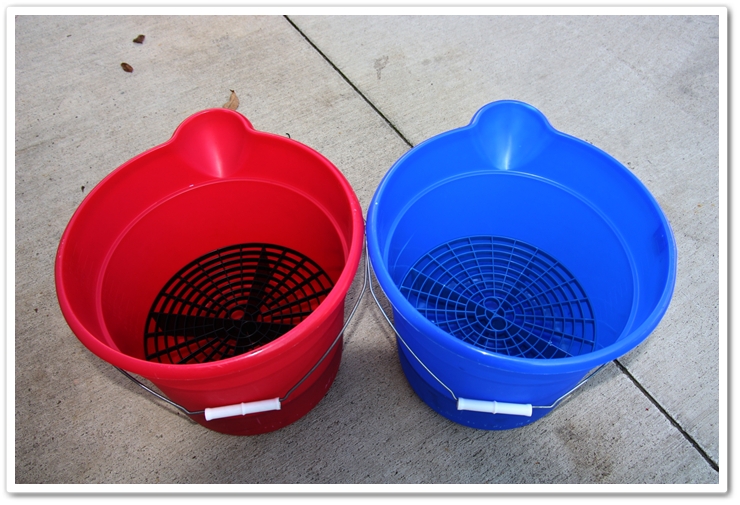
All 3 buckets are filled and ready to go.
Wash your wheels first!
One thing to keep in mind for wheel cleaning is that you always want to start the car washing process with the wheels first. The reason we do this is because the wheels are typically the dirtiest parts of the car, and we don’t want to risk overspray from the wheels getting all over a clean painted surface.
Make sure that you have a dedicated bucket and wash media strictly for wheels! Never use your wheel washing materials on painted surfaces. Ever! There are too many abrasive contaminants on the wheels, and if you were to use it on the paint afterwards, you’ll most likely damage the finish.
Use your Mini EZ Detail brush to get inside the tight areas and to reach the inner barrels of the wheels.
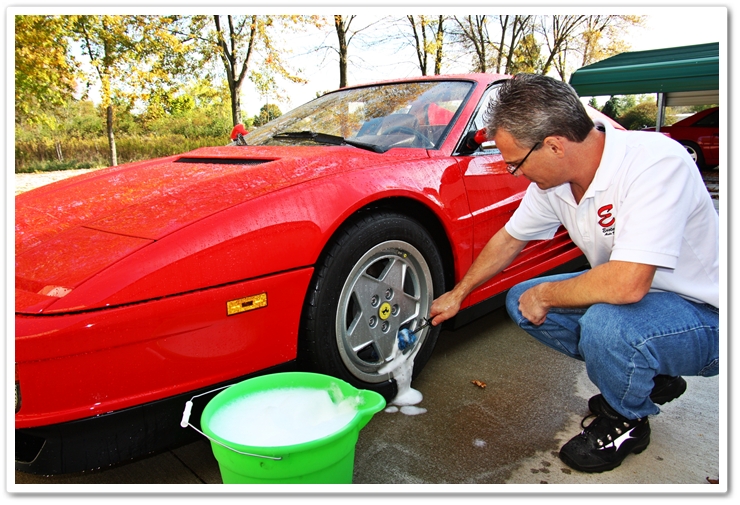
Then use a sponge or soft cloth to clean the face of the wheels.
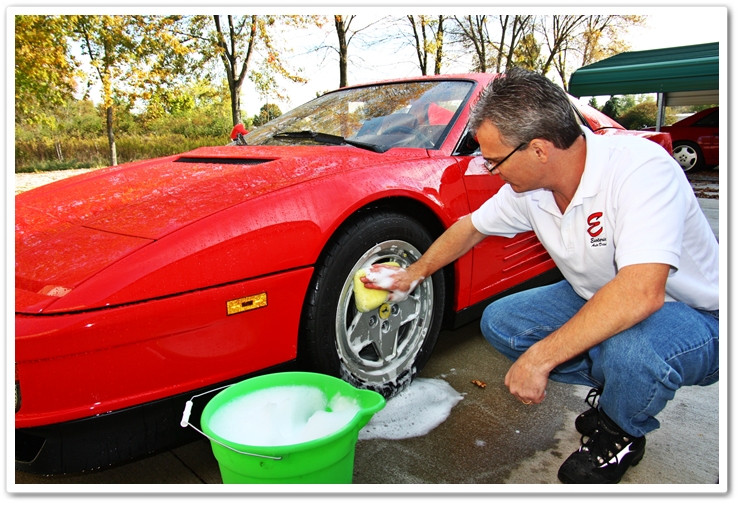
Make sure that you thoroughly rinse out your wheel brushes and sponges before dipping them back into your wheel wash bucket! If not you will contaminate the water, and by the time you get to the final wheel you would be washing with mud!
For more detailed information on how to properly wash wheels and wheel wells, please refer to my wheel detailing tutorial.
Proper washing for a swirl-free finish!
To avoid water spots and streaking, you want to make sure that the surface of the vehicle is cool to the touch, and preferably in the shade.
First you want to pre-rinse the surface to remove as much of the dirt and debris as possible. Try to avoid using a strong stream of water as the pressure on heavy particles can potentially scratch the paint.
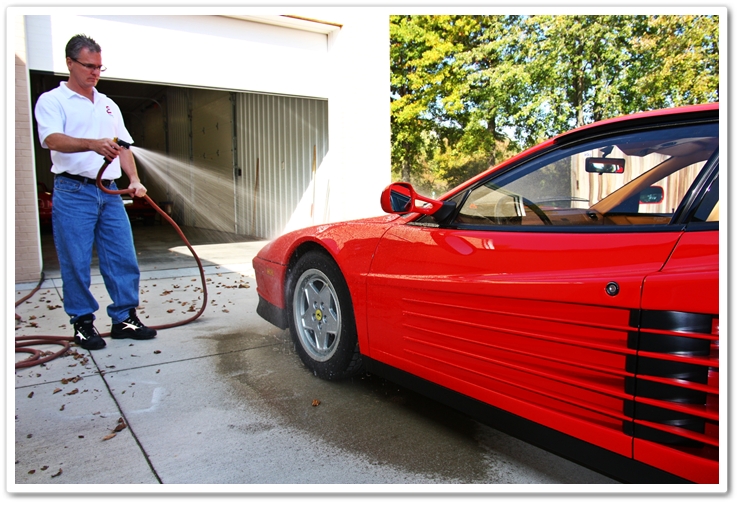
If you have any heavy contamination, now is the time to pre-soak it with an all-purpose cleaner. Follow the manufacturer’s instructions on how long to allow it to dwell. Here I am using P21S Total Auto Wash.
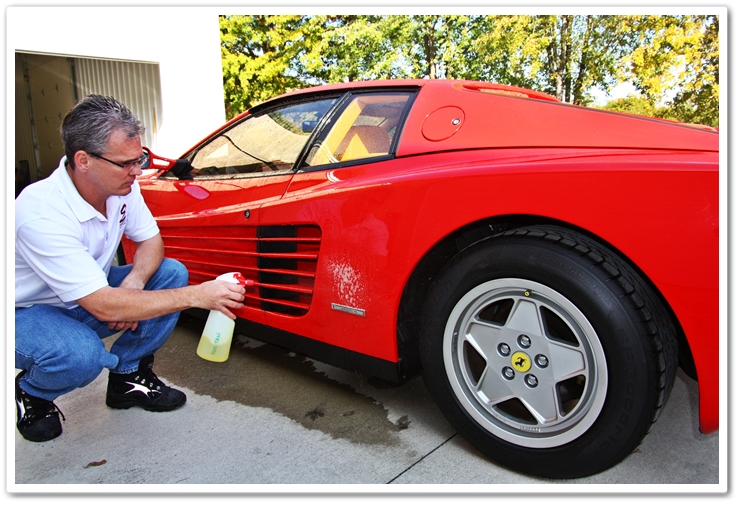
When washing the vehicle, start at the top and work your way down. Wash the roof, windshields, hood, trunk lid, and then move down to the sides.
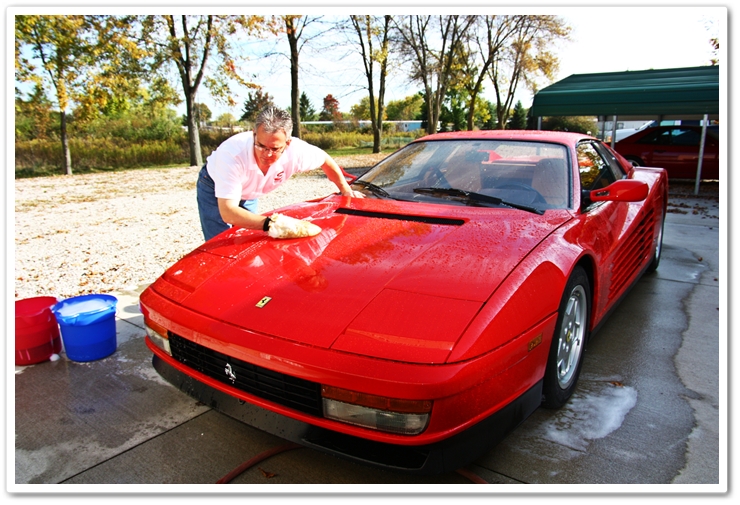
Dip your sheepskin mitt into the wash bucket, and then clean one small section at a time using little to no pressure. You’re merely trying to float away dirt and debris from the surface. When washing the horizontal surfaces on top, use a straight arm motion from front to back. I’ll typically work a section roughly 3’x3’, and then thoroughly clean out my wash mitt in the rinse bucket before moving on.
Wash horizontal surfaces in front to back motion.
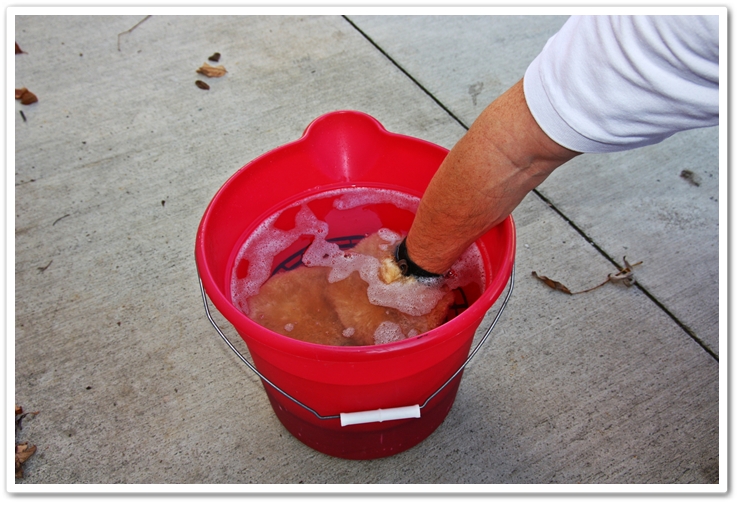
After washing each small section, dip your dirty mitt into the rinse bucket and agitate against the Grit Guard at the bottom of the bucket. This will help to dislodge the dirt and debris from the mitt and keep it at the bottom of the bucket. After rinsing, then dip it back into the wash bucket (agitate against Grit Guard in wash bucket also) to start the process over again. Rinse the vehicle frequently and don’t allow soap to dry on the surface.
Note: When you finish washing the vehicle, your wash bucket should be as clean as when you started. Never introduce dirt into your wash bucket!
Agitate wash mitt against Grit Guard.
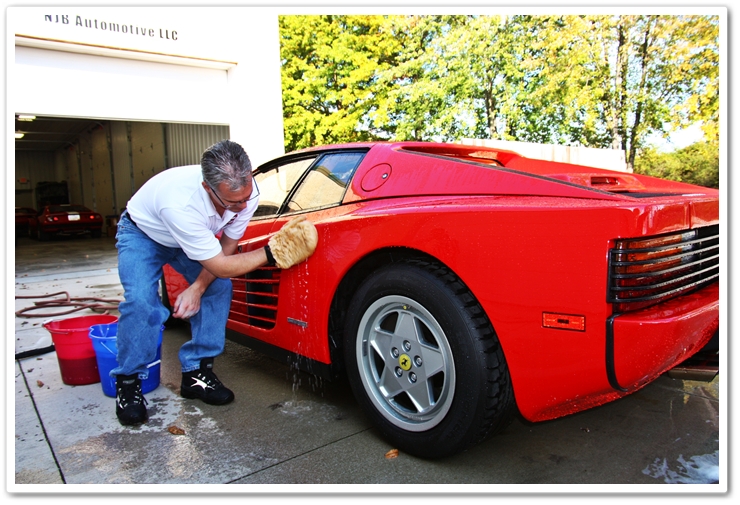
Now that you’ve finished the horizontal surfaces, move on to the vertical surfaces and work your way around the car. Here you want to wash in straight up and down motions and in small sections the same as you did on top. Rinse your wash mitt frequently, and I would recommend using a completely separate wash mitt or sponge for the lower areas if they are exceptionally dirty.
Wash vertical surfaces in up and down motion.
As you make your way around to the back of the vehicle, take a moment to wash the exhaust tips using your wheel bucket and Mini EZ Detail brush.
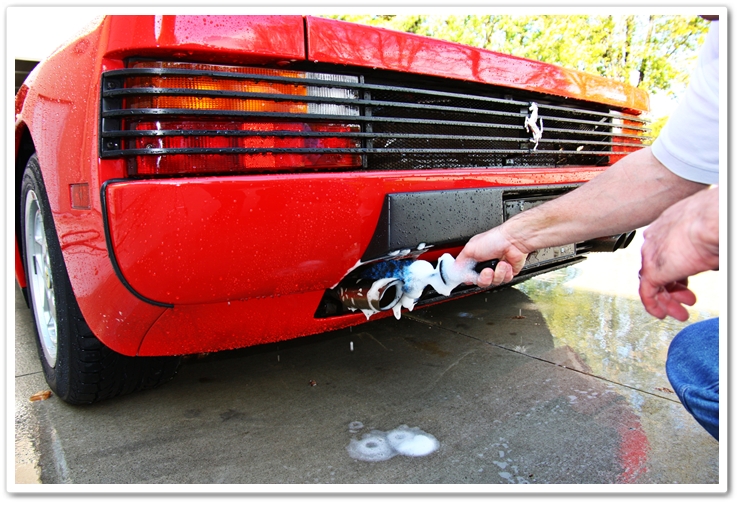
For more detailed information on how to properly clean your exhaust tips, please refer to my exhaust tip detailing tutorial.
Note: After every time you wash your car, be sure to thoroughly clean out all of your buckets and wash media. While cleaning your wash mitts in particular (I wash mine by hand in the sink), carefully inspect them to make sure there are no foreign objects imbedded into them that could cause damage to your paint. Also allow them to dry completely before storing them so they last longer. Should you ever drop your wash media on the ground during the washing process, then grab a spare to finish the job…one small piece of debris could wreak havoc on your car!
When doing your final rinse, take the nozzle off of the hose and allow it to flow freely over the surface. This sheeting action will prevent water droplets (that cause spots), and will reduce the amount of actual drying required.
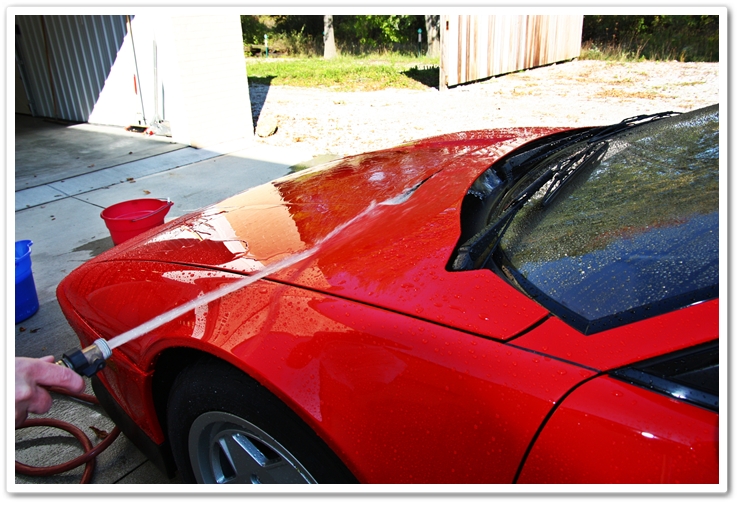
Time to dry and shine!
We’re done with the wash process now, so let’s move on to the proper way to dry it to keep from marring the finish.
Just because you’re armed with some microfiber towels it doesn’t mean that you’re not going to induce swirls in your paint. You also need to have the right kind of microfiber, and care for it properly as well. You have to use a very high quality microfiber towel, and use light pressure. For drying I use the DI Waffle Weave Towels, and for buffing I will use the DI Great White or Ultra Plush towels.
The first thing I do after washing is to use compressed air to blow off all of the standing water, and water that hides in all of the cracks and crevices. The less you have to touch the vehicle the better. If you don’t have access to compressed air then don’t worry because you can still get it done the old fashioned way.
Now that you’re ready to dry it off, first take your microfiber towel (lightly spritzed with your instant detailer for added lubrication to prevent marring) and gently drag it across the finish to remove the majority of the water. Here I am using the Waffle Weave microfiber that is capable of absorbing up to 5 times its weight in water.
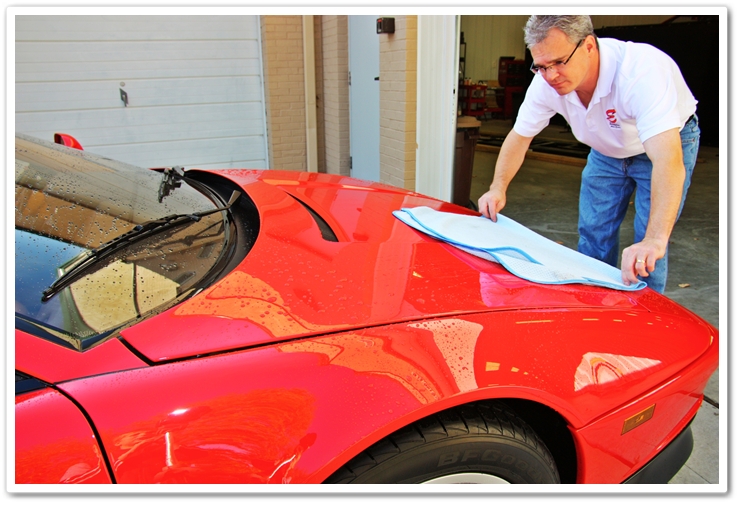
Or if you have very little standing water you can use a blotting method.
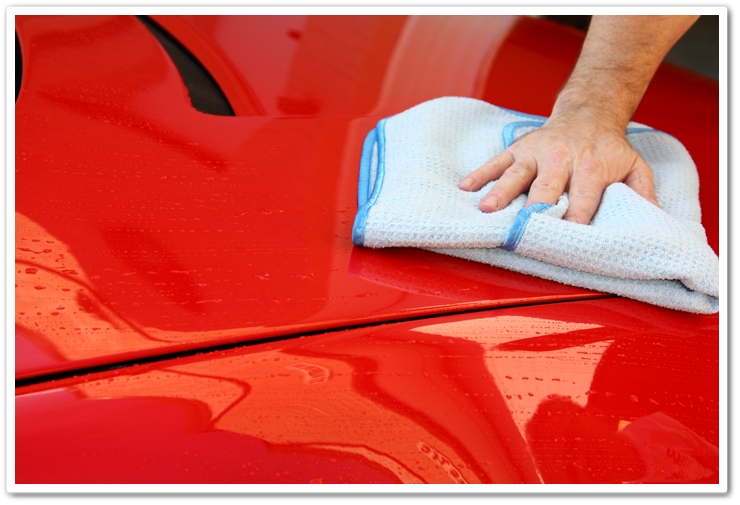
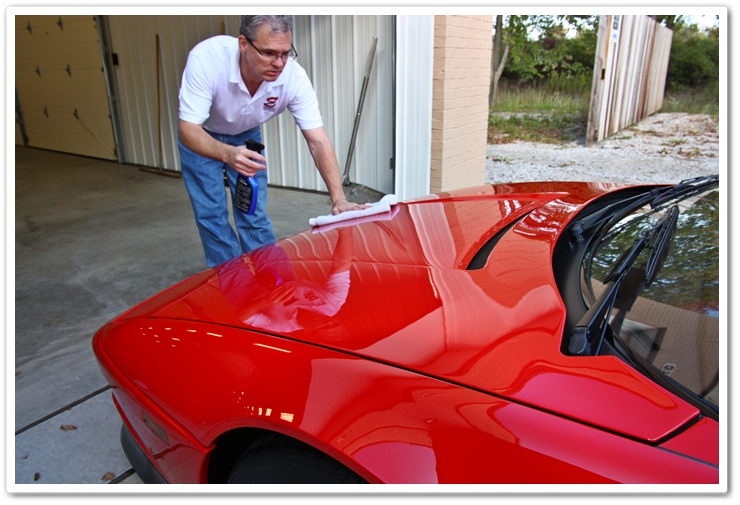
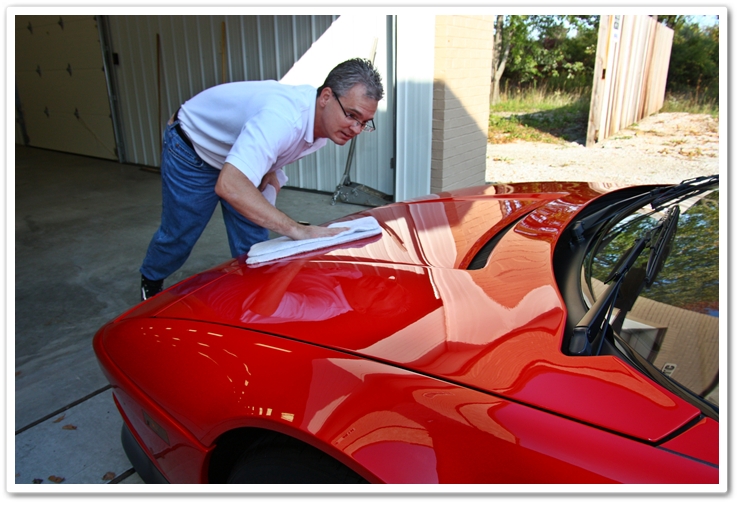
This will leave a little bit of water on the finish, and you want to get that wiped down to avoid streaking. If you just buff that out with a plush, dry microfiber, you still run the risk of marring the finish. For this step, you want to add some lubrication using either a Quick Detailer or a Spray Wax . Use a fine mist either on the surface or directly onto the towel, and lightly buff to a brilliant finish. If you spray directly onto the surface, and end up with streaking or smearing, then try misting a little bit directly on the towel instead. With today’s spray waxes, they’re very easy to use and can be applied to all surfaces without fear of staining trim. By using this method, you’re also drying and waxing all in one quick step! This method is quick, easy, and it is very safe for the finish of your car.
First apply Quick Detailer or Spray Wax.
Then lightly buff to a brilliant finish.
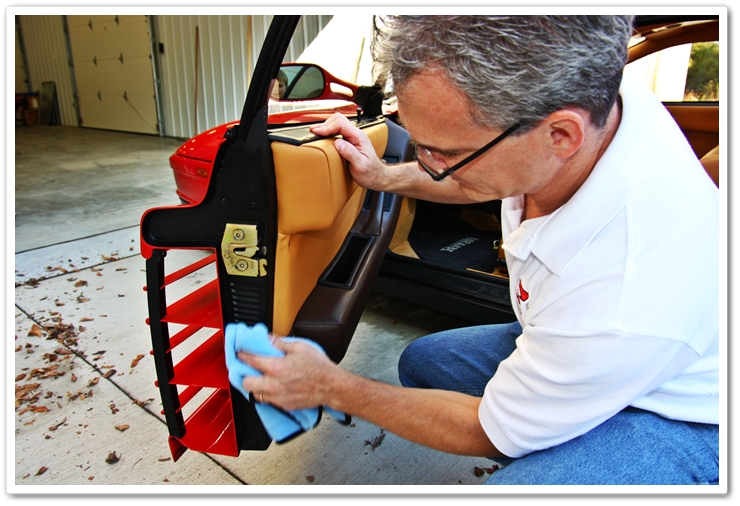
Once this step is completed you should reach for a general purpose microfiber towel for the finishing touches. I reserve my most plush microfiber towels for exterior painted surfaces, and then I keep a set of general purpose (less expensive) towels for cleaning areas like the door jambs, behind the fuel filler lid, and drying the wheels. Never mix your plush towels with your general purpose ones.
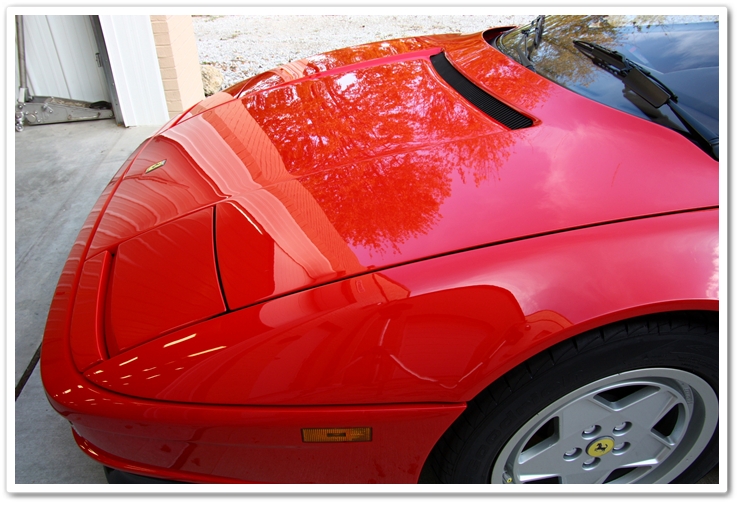
All Finished!
If you follow those key steps in washing and drying, you should be able to keep your vehicle looking its absolute best without inducing swirls in the washing and drying process. Once you get this system down, you should be able to complete the entire process in an hour or less.
Buy Products From This Article
Purchase the products used in this article individually or in one convenient package here!







This is a great write-up. My question though is that you mentioned it would be easiest to dry off standing water in cracks and crevices with compressed air and if you don’t have access to one, use the old fashioned method. What’s the old fashioned method?
Hi Alex!
I can see where that statement could come across as a bit confusing…sorry about that! 🙂
Actually what I meant is that compressed air is great because you don’t have to touch the paint. The old fashioned way is referring to drying with a towel as per the instructions. If you don’t have access to compressed air, then get into the hard to reach places as best as you can.
I hope this helps.
Thanks,
Todd
Todd,
What about using a cordless power blower instead of compressed air? I don’t own an air compressor.
Thanks!
Ken
Nice Post, Good Advice.
Question:
How can I make my car, which currently looks like the black one from the second pic (under This is what paint should look like) to the first pic.
Would appreciate the applications products used that can be purchased from detailedimage.com as well as the proper techniques.
Thanks!
David,
What I would recommend first is for you to read through the 4 part tutorial on detailing a 2006 Acura TL (black) This goes over all aspects of detailing, including assessing the damage of the paint, pad and polish selections, and just about every other area of the car as well. Once you review this and get a good idea of tools, products, and processes required, I would also go through our Detailing Guide as you will find a lot of very helpful information in there as well.
You may not get that same level of paint correction on your very first try, with with a little practice you will be amazed at what you can achieve.
I hope this helps,
Todd
Thanks for the response Todd.
Todd, I stumbled onto your site from the NASIOC site, and i must say thanks.
I just picked up a Dark Grey Metallic WRX and forgot how difficult the dark paint is to keep “nice” then on my old silver car.
Thanks!
I’m glad you found your way over Graham…please check back often as we’re continuously adding new content.
Thanks,
Todd
[…] Also… never go over a section more than 2-3 passes with your wash mitt. Refer to this as well: How To Properly Wash and Dry a Car – Detailed Image […]
It’s the ANTI-REVERSE-CORRECTION manual.
Hi Todd,
Why do we have to wash the vertical areas in up and down motion. Aren’t we moving the dirt from lower areas to the upper areas?
Thanks!
Luis,
In case you get abrasive debris trapped in the wash media that could cause scratching, I find that vertical scratches are harder to see than horizontal ones on the vertical surfaces.
Hi Todd,
In the step where you’re using the quick detailer to remove the remaining water after initially drying, are you using a new micro fiber towel or the same towel you were drying with?
Thanks!
Paul,
I am using a new microfiber towel for this step…
Thanks,
Todd
Is it safe to use the Calfornia Duster to dust the car between wahes?
Roger,
While it may be safe, it’s not something that I personally would use. Dusters typically use some kind of parafin wax in their fibers to catch debris. This debris will stay in it and you could potentially do more harm than good by continuously dragging abrasive debris across the surface of the car. When people ask me what to do with the car between washes, I simply tell them that I always take the safe route, and let it get dirty until the next wash.
Hi Todd , I like the way how you explain the process ,do you think I should go to any training center and learn more how to detail a ferrari and doit my self ,Im from Texas and I would like to know if you can recomend me a place near to my area where I can go?
Just wondering!, I use PS21 wax on my 2010 C-6 Corvette, between washes I use a spray detailer is it possible that I’m removing the PS21 with the detailer. Thanks, Mark
P21S wax looks great, but doesn’t have a tremendous amount of durability. Even without using anything that could potentially strip it from the surface, you’ll still want to apply a fresh coat about every month if the car is getting regularly driven and washed. If the quick detailer has strong cleaners in it, then yes…it could potentially break down the wax prematurely. Will it make a big impact? Probably not…
Hello Sir,
Was just wondering how long does it take for you to wash the entire vehicle which includes cleaning the wheels and wheel wells. Do you use a foam gun too even if you are just washing?
Paulo,
It typically takes me about an hour to do a full wash and dry including wheels and wheel wells. If the surface is exceptionally dirty, I will typically use my foam gun as well to provide extra cleaning and to further lubricate the surface to prevent scratching.
Is it safe to use a California Water Blade to dry a car or would it scratch?
Kris,
I think the answer to your question can be found in this article.
Thanks,
Todd
hi todd,
i live in an apartment and there are many restrictions of not making a mess while washing the car. every 15 days i do a full wash where i use the conserver for my DiamondBrite paint protection. i would really like you if you could advice me on how can i keep my black LX570 Lexus clean on a day to day basis. the car doesnt usually get much dirt just the black color shows dirt here and there. i have 4-5 microfiber cloth and finishing cloths and microfiber mitt with me. if you can give me advice on how to wash the car with water and not making a big mess and making sure i dont leave any swirls or scratches. also can i use spraying bottles filling them up with water rather than using buckets ?
thank you and looking forward to your reply.
Regards
Abab,
If you have water restrictions, you may want to consider doing a rinseless wash with a product like Optimum No Rinse. DJ Mayo has put together a great tutorial on how to use this product without having to use a hose or a lot of water. With a black car, it will get dusty from day to day, and your best option is to simply allow it to get a bit dirty between washes. If you attempt frequent “wipedowns” to get rid of the dust, you significantly increase your risk of adding swirls. You could use Optimum No Rinse in a spray bottle, thoroughly spray down a panel, carefully wipe it down with your microfiber towel (that has been made wet from the ONR spray solution), and then immediately dry it off. Then move on to the next section. I would only use this modified Optimum No Rinse procedure on occasions when you have very light dust to remove.
For my black car, I simply allow it to get dusty and dirty between washes!
thanks for your reply Todd,
but i live in Dubai and over here we can not find the product at all. i have looked everywhere and its just immpossible.
can you suggest me if washing the car once a week with just water is a good idea ? every 15-20 days i can wash the car with shampoo and my paint protection conserver.
please do keep advising me on this.
this is actually my first car in black and i want to take good care of the car as much as i could.
awaiting for your prompt reply
thanks 🙂
Abab,
Chances are you’ll need to find Optimum No Rinse online where it can be shipped internationally. Have you tried any European suppliers?
You definitely don’t want to wash the car with just plain water. Not only does shampoo provide cleaning, but it also provides needed lubrication to allow the dirt and abrasives to be gently floated away from the surface. In the case of a product like Optimum No Rinse, it actually encapsulates the abrasives to allow them to be safely removed.
As for your other questions:
1. Although I am not familiar with the properties of your brand of paint protection, I doubt that most spray waxes would do any harm to the durability. Just make sure that the spray wax is a pure wax, and doesn’t include cleaners (it would probably say that it’s a “cleaner-wax”).
2. The answer to this one may be better served if contacting the manufacturer directly. This is not a common detailing term, so I don’t want to speculate on their definition of it.
I hope this helps.
Mr. Todd,
I had few other questions to ask you as you seem an expert to answer them.
1. if i use spray wax after my wash will it damage my DiamondBrite paint protection.
2. also i have to use a conserver for my paint protection once a month. on the bottle it says i could use it “neat”. would you mind explaining what does it mean by using the conserver “neat”.
thanks alot.
Very good write-up! Thanks a grand!
Q. I tried to buff out some deep scratches with a rubbing compound that was not safe for clear coats. As you can imagine, I am so disappointed with myself for making such a stupid move. I’ve tried polishing with Meguiar’s Ultimate Compound but to no avail. I definitely took the clear coat in a few different sections.
Q. What can I do to get the deep scratches out that were caused by the compound or will I have to have the entire section repainted?
Thank you.
If it didn’t go completely through the clear coat (which would take a tremendous amount of effort by hand), then it can be fixed…or at the very least it can be made better. You probably want to find yourself a professional detailer and see what they can do to restore the finish for you. If you go to a body shop, they’ll most likely just want to re-paint it.
thnaks for all your tips Mr. Todd
i had another quick question that after washing my car using the techniques that you have greatfully mentioned. can i use a car wax after the wash and then wipe it with the microfiber cloth?
will the car wax remove the swirls, because i dont worry about the shine because its a brand new car just 4 weeks old but i dont like swirls so therefore will the car wax help to get any kind of swirls out?
awaiting for your reply,
thanks once again :d
Also Mr. Todd,
would you suggest to use a polish or a wax after the car wash in order to remove any swirls ….do keep in mind the car has just got a paint protection on it and its brand new.
thanks A LOT !!!!
Mr. Todd,
for my new car do you suggest 3m cleaner wax? as mainly my concentration is to get rid of any kind of swirls.
also can you explain me the difference between cleaner wax and pure wax :s
thanks 🙂
A cleaner wax typically has mild abrasives for polishing out light swirls by hand, whereas a pure wax is just that…pure wax with no abrasives. Another product option would be Meguiar’s NXT because it’s a wax that also has the ability to remove light swirls.
Hi Todd,
Do you ever use a foam gun (like Gilmour Foamaster II) in your workflow?
Any unfavorable aspects associated with using a foam gun; i.e. more swirls, high soap consumption, etc.?
One curious thing about foam guns is the amount of soap used to create the foam. The amount of soap required to create so much foam, would seem capable of stripping the sealer/wax. If this true and I wash my car weekly, I wouldn’t want to use a foam gun because I may strip my sealer/wax. Perhaps using a PH neutral soap would prevent this. Any thoughts about this?
Thank you.
-Albert
San Jose, CA
Albert,
Yes I do use the Foamaster II from time to time. I wanted to keep this article simple however and introduce the overal technique and process without the foam gun (need to do a separate article on that one).
You can adjust the dillution rate when using the foam gun, so as long as the particular soap you’re using is safe for 1oz per gallon (the least soap per gallon setting on the foam gun), then you have no worries. You could actually dillute it even more if you like by adding water into the foam gun container if you like.
When using the foam gun, you still do the same multi-bucket wash procedure as outlined in this article, but you’re either pre-soaking with the foam gun, or you’re spraying the foam onto a panel just before you wash it. The foam gun is great when you need extra cleaning ability (pre-soaking), or if you want to add more lubrication to protect the surface.
Great info!
Thanks Todd!
Todd,
I’m looking for an economical product to degrease the lower half of the vehicle that is clear coat safe. Would Meg’s APC+ work fine at about a 10:1 ratio? It seems as if this product would be fine for paint, but the product’s description doesn’t really come out and say it exactly.
Kris,
That is a very good option, and one that I use from time to time for the same application (or pre-soaking the front end to aid in bug removal). A note of caution however as with any other all purpose cleaner…don’t use in direct sunlight or on a hot surface, and don’t allow to dry.
Hi Todd,
Which is the best product that can after a month or two on the car after doing a proper 6 or 7 step treatment with synthetic sealant? &
what is the best product for 1 step polishing & waxing currently i use Meg’s Quick Detailer ?
What is best ‘grit guard’ and ‘waffle weave microfiber’ and/or any other product that is NOT mentioned or for sale on this site? I just purchased a 2007 Honda with Nighthawk Black Pearl and I am PARANOID about it becoming ‘swirled’, etc. The problem is that I live in California in an apartment and have limited space as it is. I am told that ‘carnauba wax’ is the ‘best’, but what brand? What kind? And what do I use after EVERY wash since I understand that ‘carnauba wax’ is only supposed to be used twice a year?
What about for the inside? I have leather wipes for the seats, but what about all the rest? ArmorAll?
I’m just curious if you have any other recommendations as everything on this site seems to be exorbitantly priced- and, unlike a Ferrari, not everything that is ‘expensive’ is necessarily ‘the best’.
Thank you.
Steve,
Thanks for checking in. Let me start by clarifying a few things for you. First of all, Grit Guard is a name brand, not a type of product. Yes, carnauba is very good wax, and yes there are many different types and prices. You can easily go from $15 up to over $1000 for a jar of carnauba wax. And to say that it only needs to be applied twice per year is incorrect. Most paste waxes only last 4-6 weeks, whereas sealants last 4-6 months. And both of these products only protect from the elements…they do not protect from swirls.
And I must disagree with your statement of the products being “exorbitantly” expensive. If you’re looking for the results that most professional grade products provide and the educational material that is available for and about them, then this is what they cost (regardless of where you look). If you’re comparing them to the prices of many of the over the counter products available at your local auto parts store, then yes…they are typically more expensive. But you won’t find true professional detailers using those over the counter products because they can’t get the same level of results out of them. Professional detailers like me, and like the other authors here on the DI Blog use (and write about) what works.
Take your time and go through the blog here as we have the most comprehensive collection of educational material, product reviews, tutorials, etc that you will find. Each author has spent countless hours testing, evaluating, and writing about products, techniques, and processes that work so that both people like you who are new to proper detailing, and experienced detailers alike can learn the right way to do it. We’re taking out the guess work for you, which can also save you a lot of money in the end so that you don’t purchase products that don’t get the results you were hoping for. As for the chamois, it’s like many products in the detailing (and other) industry…technology changes, and better products come along that work better.
Here are a few articles you should probably read:
Ask A Pro Blog, What it is and How to use it
Proper Microfiber Care
How to care for your wash mitt
A complete detailing guide for Nighthawk Black Pearl Acura/Honda paint (includes interior detailing product/process recommendations)
If you’re paranoid about creating swirls in your paint, then follow the product recommendations and techniques outlined in this article, and the ones that I linked you to. Swirls come from improper washing and drying (which includes improper care of your wash media). If you follow these procedures, you will significantly reduce the risk of causing any damage to your finish.
Thank you, Todd!
Yes, well, I broke down and ‘splurged’ for multiple items from this site (even though I had to go into my ’emergency reserve’ to do so)- as a result of reading and reading a lot of these blogs. (and 4 grit-guards- however, I cannot find any 3.5 gallon colored buckets now. LOL) Yes, I’m type-A and obsessive/compulsive probably. 😀
303 Aerospace Protectant – 16 oz
DI Microfiber The Great White – 16″ x 24″
DI Microfiber Ultra Plush Two Sided Towel – 16″ x 16″
DI Microfiber Waffle Weave Drying Towel – 36″ x 24″
Dodo Juice Born to be Mild Shampoo – 250 ml
Lake Country Blue Grout Sponge
Lake Country Red Foam Applicator Pad
Optimum Instant Detailer & Gloss Enhancer – 17 oz
P21S Gel Wheel Cleaner – 500 ml Kit
P21S Total Auto Wash – 1000 ml Kit
However, as you can see, I am missing a ‘wax’ and/or ‘sealant’. And, as I mentioned, I have an 07 Honda Accord with Nighthawk Black Pearl paint. (And, yes, I am a HUGE fan of the ‘blue flake’.) It just worked out that way- I wasn’t even looking for that in particular.)
Thank you so much!
Steve
Detailed Image sells blue & red 3.5 gallon buckets
Oh, yeah, I forgot- why don’t you use a ‘chamois’? I always heard that was the ‘best’ way to dry.
THANK YOU!
Todd, where did you buy your wash buckets (red, blue and green colors)? Or does anyone else know where to buy them?
You could probably pick those up at your local home improvement store.
Ok, Todd, so I finally ‘detailed’ my car with the plethora of items listed above that I purchased. I don’t think I did something right because my results weren’t nearly as impressive. Two grit-guards seems like snake oil- I think one would suffice if it works the way it says. Otherwise, why not just make the one grit guard twice as wide as the one?
The ‘waffle weave’ drying towel did not dry the entire car- at all. In fact, there were spots all over the car near the end. I’m not sure what the P21S really did- if anything- I used it in the wheel wells and around the bumpers, but still not really sure that it made any difference.
I picked up the Chemical Guys Pete 53 Black Pearl wax and applied a coat of that by hand, and then the following day- after spending 4-hours the day before- there was a fine dust all over the car. Which I guess came from where I park it at work. I still see swirls in the paint and it doesn’t look anything like your photos. Granted, you’re a total professional and use the Porter Cable machine, but still.
Needless to say, I was pretty frustrated about the dust. Will I have to wash the car once a week and if I do that- do I wax it every time? I also picked up the ‘quick detailer’ spray- but am I just wiping the dust into the paint?
I didn’t pick out this color- it was all they had. I would have much preferred champagne color or silver metallic, but anyway.
Thank you for your time and I appreciate any suggestions from anybody on the board.
Steve,
You have a lot of questions, so I’ll address them individually.
Grit Guards…if you use a 3.5 gallon bucket, you have to use just one Grit Guard…two take up too much space. So the Grit Guards are made smaller to fit a wider variety of buckets.
Waffle Weave…you will need to wring out the towel several times during the process. The towel should removal the majority of the water, and per the guide, any remaining water should be wiped down in a secondary process with your plush MF spritzed with either quick detailer or spray wax.
Paste Wax…wax is not designed to remove or cover up swirls. The only way to remove them is to polish by machine. As for your black car, they can get dusty 10 minutes after fully detailing them. Especially on your NPB paint, I don’t recommend trying to wipe it down with a quick detailer to remove the dust. Just wait until the next wash cycle if you want to prevent adding swirls. If you use a paste wax every 4-6 weeks, you should be good.
P21S…you should only need to use this when you have a high concentration of dirt/grime buildup, and it will help to break this down prior to washing.
The entire process is different than what you have done before, and takes time and practice to make it your “normal” routine. A proper wash routine won’t magically transform your car into a show vehicle. The key with it is to get the car clean without causing any damage. The pure gloss and high reflectivity you see in most of the photos you will find on the blog here comes from the machine polishing stage.
When done properly, this system works well to keep your car looking its best. My NBP TL-S is 4 years old with 60k miles on the clock. In that time I’ve only done a few light polishes, and some spot polishing…never an intense polish. And even with that, and going through harsh Midwest winters, you will be hard-pressed to find any signs of swirling or light scratching on it.
I hope this helps.
Thank you for being so patient. I was thinking that maybe my post came off a bit harsh- that wasn’t my intent. I apologize if it came off that way.
You’re absolutely right about the two-guards. (LOL) I was thinking that I was going to have to get at least a 5-gallon bucket to fit both AND have any room at the top. I tried Lowe’s and Home Depot and the guards don’t fit in the bottom of either. I have 4-now and no buckets. 🙁
Yes, I agree and also realized that my car wasn’t going to look anything like your Acura, but I was hoping it would be close.
I’m way too obsessed about ‘details’/perfection instead of just doing it. It will take time to get used to the 3-buckets, but I did spend a large amount on the car so I will have this car for many years and want it to stay nice. I also spent a lot on all the products, as I mentioned.
One last question- sorry- but, do you not recommend waxing it every time I wash it? Is ‘liquid’ wax the same as ‘paste’? What about a ‘carnauba cleaner paste wax’- as opposed to my Pete’s 53? Is the ‘cleaner wax’ ok to use more than every 4-6 weeks or no?
Steve,
There’s no need to wax every time you wash the car…unless you simply enjoy waxing. The liquid waxes typically are more polymer based, whereas the paste waxes have a high carnauba content. A spray wax like Optimum Car Wax is very quick and relatively easy to use if you wanted to do it more often. Cleaner waxes usually have mild abrasives in them, and I don’t recommend that for the soft NBP paint.
Thanks for the info, Todd! If you’re ever out in San Diego, CA- and you bring your tools of the trade- please let me know. (LOL) Although, I’m sure I’ll have to start saving my money now for your well deserved fee.
I’ve been to OH twice, but never to Cleveland. Nice people everywhere I went, though.
Thanks, again.
Hi Todd,
Would you suggest using a Grit Guard in the tire bucket as well? Or is that unnecessary overkill?
I can not tell from the images if you have them in your tire bucket.
Thanks.
I wouldn’t call it “necessary”, but I DO use one in my tire bucket as well! 🙂
Even if you rinse out your brushes after each wheel, and before you put it back into the bucket, you’ll be amazed at how much grit will accumulate at the bottom by the time you’re done.
Todd,
In addition to my question above, I was also wondering about the difference between the Spray Wax and Instant Detailer.
What is the difference between the two? Why is it better to have both? Would you use them at different times?
Any help is greatly appreciated.
Thanks.
You will be using a quick detailer much more often than you will a spray wax. For instance, you should be using your quick detailer during your drying process each time you wash the car, whereas you may only be using your spray wax every third or fourth wash. A quick detailer doesn’t offer much in the form of durability, but most spray waxes do. I will use a quick detailer to remove/prevent any water marks or streaks and to add some gloss in the process. I use spray wax when it needs a shot of gloss AND protection.
Awesome!!
Thanks!
Hi Todd
Very informative. Thanks for all the knowledge you shared with us. I am from India and have a VW Polo. This is my first car and it is in Candy White color. After reading this, I know how much abuse I have put my car to. I would like to ask few basic questions.
1. In my place, it is very dusty and the car can become dirty in 2-3 days. What do you suggest to keep the car shiny every day. Do you recommend a daily wash?
2. For New cars that are less than 6 month old, do you suggest any paint protecting rubbing, waxing or any other treatment. the guys at the car washing place always tell me to avoid doing any waxing/ rubbing on a new car. They want me to get my car paint dull first and then I have to go for any treatment. Do not understand this logic. What should I do with my car to protect the paint finish and more importantly, how to keep the Glossy feel of the car?
thanks!
If you live in a very dusty/dirty area, then you definitely want to make sure you keep a fresh coat of a paint sealant and/or a wax on it. This will both protect the finish, and make it easier to keep clean. With that much dust, the only thing to do is wash it because if you try just wiping it down with a quick detailer, you’ll just scratch the finish. There are rinseless wash options and here is a link to a good article on that topic.
Yes, brand new cars need to be treated accordingly. Here is an article on new car prep that may be helpful.
You’ll find a lot of helpful articles here on the DI Ask A Pro Blog, so take your time and browse through the categories on the left side of the page.
Thanks for stopping by!
Todd
Hi Todd,
For the past few months I have been using your wash methods and I have seen a tremendous improvement in the look of my paint. I only wish I had come across your tips sooner so I wouldn’t be stuck with the ugly swirl marks on my soft Jet Black BMW (I may have to visit you soon enough to rectify this =) ).
My question, however, pertains to the spray wax. I can not for the life of me figure it out and I was hoping you could assist me.
After drying the car with a waffle weave microfiber. and using optimum instant detailer and gloss enhancer for lubrication, I attempted to utilize the optimum spray wax and gently buff with a microfiber buffing towel. However, I was left with a sticky and visible residue on top of the paint. I quickly panicked and removed it.
How can I apply the wax properly and have it look good? Did I just not let it sit on the paint long enough? Did I apply too much or too little spray wax? Is there something I should be doing after I spray and wipe?
Any help is greatly appreciated as this is completely new territory for me.
Thanks.
Armand,
There are a couple of things you can try. It’s hard to tell if you’re using too much or too little just from the description. And on black paint, the Optimum Spray Wax can get streaky if you don’t use it just right.
On your next wash, try using the spray wax during the drying stage instead of the quick detailer. Test it out on one panel by doing a light spray onto the lightly wet surface and then wiping it down with your waffle weave towel. Immediately then take a fresh microfiber towel and very lightly buff off any residue or water/wax streaks that may be present (if any). If you used too much product, you should find that you have to do a lot of light buffing to remove the residue.
What I’d recommend is using the QD during the drying process, and then every 4th wash (or so) use the spray wax instead. If you try to use both together, you may find it more challenging with streaks and smears as you’re currently running into.
Let me know how it goes.
Todd,
Thank you very much for the tips when using the spray wax.
Came out great!
I think I was spraying too much product and trying to cover every inch of the car, forgetting that the wax will spread once I buff gently with my microfiber towel. But I had to do very little, if any, buffing after drying with my waffle weave.
Thanks again.
I’m glad it worked out. Using too much product is quite common in many different areas of detailing.
Todd, I’ve never had access to compressed air, but a while back I purchased an leaf blower for yard clean up, and it also doubles as my best drying method, this might be worth mentioning as well. They can be had for as cheap as many boutique drying towels and do an excellent job drying cracks and crevices, along with an initial dry (post-sheeting) to eliminate the majority of standing water. (Only electric leaf blowers, gas powered probably isn’t a good bet.) Also, how do you feel about the “water blades”? I’ve been using them for years, but they require a large amount of caution.. These days I only use them on my windows, but they also can be had cheap and even for glass use they cut back on drying time and keep your primary towels dryer for the more sensitive painted areas.
One more question, when washing vertical surfaces, do you recommended washing to the body line (mid door) first, then rinsing the wash media, before washing the typically more dirty lower panels? Also, thanks for the write ups, they do a tremendous job informing the community, professionals and enthusiasts alike!
Thanks!
Robert,
Yes, the blowers are fine as long as they’re filtered. I’m not a fan of water blades at all…windows would be fine but I would never touch a painted surface with them personally. On the vertical surfaces, it just depends on how dirty the car is. If it’s really bad, then yes, breaking them down into multiple sections and rinsing your wash media between the areas would be a great idea.
Thanks for reading!
Todd
Todd
Great work!
Follow-up question on using blowers…I use a gas powered back-back blower on my LS460 that is not “filtered. What is the risk?
After blow drying, I use a QD with MF towel to remove remaining water droplets.
Thanks
Mike in ATL
Mike,
I’m not a leaf blower expert, but here’s my concern…if it has the ability to suck in (dirty) air and then force it out, you have the risk of potentially sandblasting your car with accelerated particles that it could pick up. It should be fine if used in a clean environment, but I just prefer to reduce as much risk as possible when dealing with delicate paint.
Todd
Came across your car detailing by accident trying to find some touch up paint. I have a 2008 Acura RL, Nighthawk Black. Beautiful color! Had an Accord before that. I love to detail my car plus its relaxing for me. Now i have a better way to detail both of our cars.
Question I have is touch up paint. Whats the best way to touch up the paint on some gouges? I have 2 on the lower part of my drivers side door.
thanks for the detailing info i will be putting it to good use.
Israel of OKC (harsh climate)
Israel,
The best way would include wetsanding and machine polishing afterwards to level out filled-in area. If you don’t have the tools or experience to do this however, then I’d just pick up some touch-up paint from your dealership, prep the scratched areas with Isopropyl Alcohol first to remove any waxes or sealants, and then when using a fine brush (I use ultra-fine felt brushes from the hobby store), put a very light coat of paint in the scratch. Allow to dry, and keep repeating the process until you’ve built up a good level of paint. I hope this helps.
Here’s my stupid question; Would you ever use a buffer to apply &/or remove wax? I’ve been doing it for years but have recently purchased a C5 Corvette (torch red) & don’t want to mess it up.
Thanks, Larry
Todd,
Great article. Can you rinse your wheel detail brush and sponge in the same rinse bucket used for the painted surfaces?
Steven
Todd,
Thank you for the great instruction. I just purchased a brand new car with a snow white peal color and I was looking for the best way to take care of it.
After reading it all, I have been going about cleaning my car incorrectly for years. Education is key and I feel like I am armed to go my car justice. Thank you again.
-Cellus
I’m glad to have helped! Have fun with your new car…
Todd… I just read your article and learned something new… the washing of the vertical surfaces in an up and down motion. Thank you for sharing your knowledge and expertise!
I have always done my vehicles following the airflow of the vehicle. I do use the three bucket method, microfiber drying towels and use a dedicated leaf blower to get the water out of the cracks and crevices. If the car is just just dusty I use ONR.
Todd,
Have you heard of and/or used TR-3 Resin Glaze on an already good condition paint? If so, what’s you opinion of it vs polished and waxes? Many reviewers write favorably about it even on good condition paint surfaces.
Sorry…I’ve never heard of that product.
Todd,
Is it important that the grid guards sit flush at teh bottom of the buckets? My 5 gal buckets have varying diameters and the GGs float 6+ inches high (off the bottom) on a couple of them.
Thanks,
Jon…while not absolutely necessary, you will get optimal performance out of them if they’re on the bottom.
I’ve read that it is better to let the soap sit because it is likely to leave water marks on the vehicle
i dont have access to a hose or water gun, is that a problem to get a good finish?
You can use rinse-less wash solutions, but they are not as safe as the traditional methods in my experience.
I just purchased a Toyota Venza with a dark metallic color. I had it perma plated by the dealer as I live near the ocean and have found the perma plate invaluable. I was shocked when I picked up my brand new car and saw the swirls and spider marks. I took it back but alas it was a cloudy day and the blemishes did not show up as bad. I was told that all cars have them and that was the new reality. I did not believe that and after reading your blog, am more convinced I am right. So where do I go from here? Do I take it back and make them make it right or do I can I make it right? I also worry about the perma plate? What effect did that have on locking in the swirls? Thank you for any advice.
Well, I’ve never heard of Perma Plate…probably just a simple sealant sold by the dealership. Your dealership is dead-wrong…new cars are NOT supposed to come with swirls. These were most likely caused by it being washed while on the lot, or in their “prep department”. Most dealerships have no clue what proper paint care is about, therefore their natural reaction is simply to say that’s the reality of paint. Unfortunately you’ll probably have a fight on your hands but I wouldn’t hesitate to ask that their district manager for Toyota gets involved if your dealership fails to take care of the problem. I would not have them do the work though…insist that a true professional is hired (which may be tough to find). The best of luck to you…
I have been told to avoid waxing a car that is less than a year old. Would it be safe to use an auto detailer in the drying process on a new car?
OEM paints are fully cured when they leave the factory, so you can use whatever kind of wax or quick detailer that you like!
Thank you for the information, Todd! Your site has been very helpful.
I take very good care of my vehicles and now have learned better ways to do so reading from your site thank you. My question for you is, one of my cars is black and was parked under a tree and has tree sap on it. I have tried bug and tar remover, rubbing alcohol and even tried 3m Perfect It compound with my Porter Cable. The compounding took some of it off but there is still some on it. Any help would be appreciated. Thanks.
Hi Rick,
You should clay bar your car. This will remove the sap and any contaminants from the finish and make it feel as smooth as glass. Then after you can apply a sealant or wax of your choice, you’ll be amazed with the results. I hope this was helpful.
Thanks for the good writeup. It actually was a leisure account it. Glance complicated to more added agreeable from you! By the way, how can we keep up a correspondence?
Just came across your site and it is very helpful. Can you provide a list of items needed to go through the process as indicated above please?
I have really enjoyed the comments here. I have been detailing cars since 1956. After washing my black 1994 Ford Escort, I use my leaf blower with the flat nozzle at the end of the blowing tube to remove the excess water from the surfaces and out of the cracks and crevices. Then I spary Wax As U Dry by Eagle One a product made by Valvoline. I use soft terry cotton towels and absort the wettest spots. I then finish off with the micro fiber towels. If I get a superficial scratch from a fingernail or a dried bird dropping, I use Scratch Out on a microfiber foam pad and it works grea too. My car usually stays clean and If I have to wipe it down I use a solution of one half Wax As U Dry and the other part water. It works great on restoring the finish back to just after washing/waxing and leaves no residue, even of the glass. Thanks again for this blog, I live to detail.
This is fabulous. I recently purchased a new car. Keeping it clean is important to me. Cleaning it the right way is essential. By the right way I mean not dulling the paint, leaving scratches or doing anything that would diminish the beautiful look of the car.
I appreciate your detailed overview of the proper way to clean a car. Thank you.
Hi Todd, I came across your site and believe me, it is going to change the way I have washed my cars for the past 30 years!!.
One thing that impressed me is the cleanness of the tyres of the Ferrari. How do you keep them clean (very black -matte-) without using oil based liquids that the only thing they do is accummulate dirt overtime?
Thanks, and again, great job.
hi todd,
great article, wish i had seen it before i took my new audi for a hand wash to a local car detail shop. i left the shop with spider lines and swirls all over the car and esp. on the black trim on the doors near the windows. is there anything i can do now to fix the situation ?
thanks
binoy
Hello just purchashed a black mustang. I was getting it washed at a detail shop and it has light swirl marks in it. I have a wax spray I use and the marks appear to be gone but only for a few days. How can I get these out permanently. I was told to use a paste wax to rid them. Thanks
Great information!
How do you feel about DI water for final rinse if you want to wash and go.
Thank you for your time.
thanks Todd for the great advice. I will be making some changes in the way I wash my 99 355 ferrari. I’ve had her for a month now and washed her a few times (incorrectly I now see!). This good looking car is black. While there is still a nice gloss and uniform paint there are “swirls” galore. Do you have any advice for correcting these? I was hoping a good quality carnauba paste wax would help but you say this is not correct.Thanks for your help. George
this above was really nice with tgousands of details but can you tell me is it needed maybe somehow gently to wash car from below, the down part of the car, where the engine is, now after the winter because of the salt on roads ?
Hi Todd,
I have a brand new car that I plan to hand wash. What kind of spray nozzle(s) would you recommend for a home garden hose?
Thank you!
Hi Todd,
I really like your articles – you are a true professional.
I wanted to ask about using Chamois to dry the car – that’s what I’ve always used (I’ve also never owned a black car and I just compound my green one whenever it starts to look dingy).
I just wanted to know if there was something wrong with chamois that I don’t know about or if it’s just an alternative.
Could I use the spray wax if I used a chamois?
Thanks, Russell
I just bought a new car and have always dried my vehicle with a a dry towel I use for showering (I know!) anyway I am sort of confused when it comes down to drying the car. So I need to remove all the water by using the waffle microfiber along with a little spray wax and then use a super plush microfiber and spray wax again after the waffle towel? I understand using the spray wax as a lubricant but didn’t understand if the waffle towel and spray wax got all the water off what the purpose was of the other microfiber and spray wax. Do I need to use either the waffle towel and spray wax or super plush microfiber and spray wax for the ENTIER car or just where water is? Thanks for all the great information, hopefully my new car will not have swirls all over it like my last !
Hello would you mind letting me know which hosting company you’re utilizing? I’ve loaded your blog in 3 completely different internet browsers and I must say this blog loads a lot faster then most. Can you recommend a good hosting provider at a reasonable price? Many thanks, I appreciate it!
Well, great advice. Thanks!
I just want to share my advice, could be very helpful, so anytime when I wash my truck I use special polish for any metals like chrome (mostly chrome) after about 45 minutes of polishing it just looks better than new. It definitely brings out the looks even more. Once again great article.
Hi,
A few questions. Is there a difference between the instant detailer and the spray wax? Other people online seem to say they are the same thing. Also you mention drying the car and then in the next step spraying the detailer or wax and then buffing it out, but then you mention you can do it all at once. Can you clarify?
Thanks,
John
I just bought a 2014 toyota tundra in black. It rained for the past 2 days and it made the truck pretty dirty. I was planning in washing it this Saturday but it’s going to rain again the following Monday. Is it wise to wash it anyway or should I wait until the weather is consistently better?
Great Directions . I just bought a 2014 black hond civic , Now i Know why people say black is hard to maintain . I been Going crazy looking for a good way to wash my car , Thanks
I recently purchased a black 2009 dts with swirls marks and was wondering the best way I could get rid of them or at least most of them. What to use and how to properly do it. Thanks
I just bought a 2014 Hyundai Sonata SE in Phantom Black Metallic. The dealer gave it to me with their dealer logo stuck on the back as well as stickers on the tires and wheels and swirls. I took it to a local detailer who removed the logo and stickers and most of the swirls. That was three weeks ago. I’ve washed it three times since then and I am still removing wax residue from the body and seams.
Am I wrong for thinking I should not have any wax residue and no swirls? How can I find a really good detailer, hopefully with OCD, that will do the type of job that I see from the examples I see here?
I’m in Chino, Calif.
Learning to clean your car for me is very important cause car has been a huge role in our daily life in fact in Finland where i am working as an sale management staff i always use my car when go to work and it helps me to come on time in office and it is my daily routine.
Todd,
I’ve seen that several people have asked about the use of a chamois but haven’t seen that you have responded about them for drying.
Any thoughts.
Thanks Bob
Spot on with this write-up, I really think this site needs a great deal more attention.
I’ll probably be back again to see more, thanks for the
information!
Hurrah, that’s what I was searching for, what a data!
existing here at this web site, thanks admin of this website.
Does the same process for cleaning & waxing, also apply to cars with black finish? Any particular products I should get for a black finish? I just bought a Camaro 2SS black/black convertible.
Thanks
Great information Todd. I have just purchased a silver Mercedes SL550 that was professionally detailed weekly for the previous owner. I want to keep it looking as good as it does now. Do you have any thoughts on the air force master blaster drying system? I know it is a little expensive, but if it works and is better for the paint, then I would think it is worth the price. Looking forward to hear your thoughts.
I prefer using paper than towel for everyday cleaning but I have never used plush microfiber towels. I will definitely try this one because I think washing isn’t as big an issue as swiping is. It becomes really difficult at times. Thanks for sharing this effective methods, I am sure they will be a great help 🙂
Your site is great. Thanks for all the info. I have a few questions: you specifically talk about light wiping during the washing process. This doesn’t deal with the bugs…. I have a 2004 maserati coupe in dark green metallic. The front and hood are absolutely covered in bugs which washing doesn’t seem to remove very easily. Also, At some point it was waxed or detailed and the upper side metal window trims have white wax lines/ residue in them. I’ve tried to clean them with microfiber but the white lines almost seems etched into the surface. Any ideas how to remove? Last but not least, do you know of an excellent detailed in the SF Bay Area for swirl restoration? I’m not going to touch my car with a buffer. I’ll leave to the experts
Todd – thanks a ton for such detailed (pun intended) instructions. I read it several times, bought most of your recommended products and am excited to clean my new car.. a black one.
When you have some time, I’d love for you to turn this blog post into a video tutorial on youtube or somewhere else for easy reference.
Wow that was unusual. I just wrote an extremely long comment
but after I clicked submit my comment didn’t show up.
Grrrr… well I’m not writinng all that over again. Anyway,
just wanted to say excellent blog!
Todd,
Interesting article, maybe you can help me understand applying a quick detailer spray after washing and drying
When I research these quick detailer sprays it seems that most contain a wax.
This got me thinking if you have applied a expensive high end wax to your vehicle wouldn’t applying this detailer spray+wax on top of the wax already on the vehicle, compromise the original wax already on the vehicle.
Drying of the windows werent mentioned in your article. Otherwise, very helpful!
Thank you so much
A very well written procedure. Thanks for sharing it. A must to follow steps by all DIY Car wash.
My husband loves his new car and he clean it almost every day. I will send him this article! I am sure that he will like it a lot! Thanks!
This is a very useful post. Thanks!
Do you have a recommendation for a sheepskin alternative wash mitt (vegan) that will be just as gentle?
So that’s what causes the swirls. Glad to have found your post.
Hi Todd is there anything out there that can be purchased to air dry my car
A lot of people totally disregard the fact that you should dry your car with either air pressure or a soft cloth that hasnt been on the ground as it could collect dust and cause scratching. Also if you decide to use a cloth to dry the car remember not to dry the car using circular motions but long even strokes! Awsome tips!
I enjoyed reading this article. As an enthusiast/professional (I can’t tell which :)) how do you recommend storing and caring for your buckets/cloths/mits/etc?
Mike – I would be happy to help! Below are how I care for each of those items:
Buckets/Grit Guards: I simply rinse these clean after washing and store them in m garage. If they are really dirty I use the same shampoo I cleaned the car off with to give them an extra deep clean.
Microfiber: I wash these in my washer on gentle, with cold water, and microfiber safe shampoo (i.e. DI Micro-Restore). I then let them air dry. If you need to dry them in the dryer, make sure the lint trap is very clean and dry them on super low heat, or just a tumble non heat setting. Any high heat will harm the towels. Once finished I use a large zip lock bag (https://www.detailedimage.com/DI-Accessories-M12/Reclosable-Storage-Bag-P510/24-x-24-S1/) for storage. You can take it a step further and place them in a draw or cabinet after packing them away in a zip lock for added protection from dust.
Wash Mitts/Sponge/Polishing Pads: I clean them with the car wash shampoo and the P21S Total Auto Wash for some extra power. Hold them under running water and wash them as you see fit. Then let them air dry and pack them away in a zip lock just the way you would the microfiber towels.
Hopefully that helps! If you have any other questions please do not hesitate to contact us: https://www.detailedimage.com/Contact/
I’ve been surfing on-line greater than 3 hours these days, but I
never found any attention-grabbing article like yours.
It’s lovely value enough for me. Personally, if all webmasters and bloggers made
excellent content as you probably did, the net will likely be much
more helpful than ever before.
Conque me imagino que pocos hemos catado un genuino salmón ahumado, como la mayor parte de productos delicatessen auténticos.
[…] your paint job and leave your car looking shiny and beautiful, you have to have some technique. Here are some easy tips on how to wash a car the right […]
[…] How To Properly Wash and Dry a Car […]
[…] look more presentable. You also need to be aware of grit and dirt that might scratch the car. After you have washed it, then you should think about a wax and polish as […]
I’ve looked through most of the articles here but have not been able to see anything pertaining to drying with a Chamois. After rinsing I have always used the Chamois cloth to dry with, rinsing it often. Does a great job. Do you have any comments about using one?
Thanks!
Can you tell me how to clean white vinyl racing stripes on a black mustang? They look dingy with embedded dirt and water spots from rain. A simple wash doesn’t remove these stains. My husband has tried wax and they do look better for a short time. Is this the correct course of action or is there a better cleaner that we could try? I would like to get on top of this problem, before it builds up too much. We are not able to keep this car in a garage and it is exposed to the elements daily.
We have lots of car all of them is Luxury, swirls is all over.. too late to read this article. Thanks for the information let me share it to my facebook.
[…] 2016 Accord Touring Coupe Deep Blue Opal Metallic Concordant is online now Quote Quick Reply post #7 of 7 Old Today, 05:32 PM white3actual Verbal Assault Specialist Join Date: Mar 2014 Location: Georgia Posts: 837 Thanks: 61 Thanked 95 Times in 79 Posts Suntek on the hood and front bumper, and ceramic coat the rest of the car. Here is a pretty good article on how to wash your car. How To Properly Wash and Dry a Car | Ask a Pro Blog […]
Todd, what’s the best microfibre clothes and solution to clean your interior LCD of your car, and the best way to get it like new… thanks Rich
I would recommend picking up a bottle of Nextzett Cockpit Premium (https://www.detailedimage.com/Einszett-1Z-M46/Cockpit-Premium-P471/500-ml-S1/). This product utilizes gentle cleaners that help you remove dust, dirt, and oils, while leaving behind a micro-barrier of protection from harmful UV rays. The surface looks richer but without any glossy appearance and the surface will not feel oily at all. It is also safe to use on your dash, gauge cluster,navigation screens, audio components, shift knobs, arm rests, leatherette, steering wheels and much more. Simply spray some product onto a clean microfiber towel (i.e. DI Microfiber Deep Blue Towel- https://www.detailedimage.com/DI-Microfiber-M13/Deep-Blue-Towel-P694/) and wipe the area down, it’s that easy! This is truly an amazing cleaner that you will be sure to love. The Meguiar’s Ultimate Quik Detailer is another great all purpose cleaner that is even more gentle if you want a second option. If you have any other questions please feel free to contact us here: https://www.detailedimage.com/Contact/
Thanks for this article. We have Luxury and Sports cars for rent. It’s very useful information for our cars. thanks
I like to place A order by phone. Please give me A phone number
Richard – Please contact us here and a rep can take care of you asap: https://www.detailedimage.com/Contact/Other/General/
[…] (Image credit for Steps 1 to 3 go to: WikiHow and Detailing Image) […]
I just made my 1st purchase, and bought P21S Carnauba Wax, 303 Aerospace protectant, Sonax wheel Cleaner,303 Leather 3 in 1, microfiber towels. We have a NEW “machine grey” Mazda CX5 suv(3 weeks old) and I am worried about small rock chips on front and hood area since I have heard Mazda doesnt use a lot of coats(paint chips easier). Would you recommend putting 2-3 coats of a sealant on first, then coats of wax over that! Taking a road trip to Gatlinburg in 2 weeks! I also have a good Meguirs paste wax, and spray wax at home. Would appreciate ANY advice you can give to protect my grey SUV, I have ruled out clear plastic paint protection, like 3M, since I am leasing, and dont want to invest hundreds of dollars, and ruled out leather car bra, since I read debris or dirt caught under neath can scratch!—THANKS, RICK
[…] How To Properly Wash and Dry a Car […]
[…] recommend using them for small jobs (as they absorb water quickly). When it comes to cleaning and drying your automobile, any interior use and some exterior use on things like rims, exhaust tips, engine bay and windows […]
If this car was actually dirty, there is no way to get it clean without touching it with a soft brush. Everyone knows there will be a thin film of dust that just won’t come off if you just use a washer and soap. I wish I was wrong.
I always find car washing easy but it becomes an issue when my car has mud on it especially when I come from my weekend off-road drive. But the tips you shared above for washing car properly are surely worth following. Though do you recommend any particular soap
[…] How To Properly Wash and Dry a Car | Ask a Pro Blog – Want to wash and dry without adding swirls and other imperfections to your paint? Learn from top pro detailer, Todd Cooperider, as he shows you step-by-step how to properly wash and dry your car, using a Ferrari Testarossa to demonstrate. […]
England boasts a very long and proud past history of developing exciting and new products, procedures, systems and also devices that happen to have a favourable influence on civilisation; which in turn really are held in high regard about the world-stage.
[…] what to do? Do it right and take your time. A good old wash: soapy water, gentle agitation, and dry. The soap will encapsulate the pollen and loosen its grip on the paint. Light agitation will […]
[…] what to do? Do it right and take your time. A good old wash: soapy water, gentle agitation, and dry. The soap will encapsulate the pollen and loosen its grip on the paint. Light agitation will […]
[…] help prevent this buildup, it’s important to wash your car using soapy water and light agitation. Soap will deactivate the […]
Great blog Todd! Been washing my vehicles wrong my whole life till now! With respect to the compressed air stage……if you blow off most of the free standing air and then attack the rest with the waffle cloth, wouldn’t any water leftover after blowing off dry by the time you get to it with the cloth? I’d imagine that would then leave water marks? If So, could I then follow up after with the detail or gloss spray? Please advise, tx.
Cars are an expensive asset for a man, and when it gets dirty it needs a proper wash so it would not affect its look. there are some really helpful tips in this blog like, to have a swirl-free look after washing, I bet that happens to most of us and this man suggested some quality products for car care.
i have always been a great fan of my vehicles, and always try to keep it squeaky-clean. That is what info I am looking for, I hope that I can imitate it. Thank for share.
Yes, i also clean my car properly and on daily basis but cleaning from down part its difficult to clean. Really you don’t often see these blogs BlueShark
Hi Todd, thanks for this detailed hacks and tips! Also, why it is important to wash the vertical areas in up and down motion? Do you have any comments about this one?
[…] Cum poti spala corect masina (fara a cauza zgarieturi) Metoda de spalat folosind Grit Guard Cum sa intretii corect prosoapele din microfibra Cum sa intretii corect manusile din blana de oaie […]
Super! Great tips! Following these simple recommendations, you can wash the car yourself and be 1000% sure that the spider web on the paint does not appear. Thank you it was cool!
Great tips! You should wash the car yourself by following these clear recommendations. Thanks, it was so cool.
These tips are still making sense in 2021. Great article every vehicle lover should read. Keep up the good work.!!
[…] to the site, reviews of various products, and ratings by people who have purchased the products. Click here to visit the site. The site owner made the process for potential clients extremely easy to learn […]
Your post is detailed about car was, i am from rental services and i really know the pain of doing this which you explained very well.
Thanks for Providing such a detailed guide on Car Detailing. You have covered all aspects of Car Washing and dry after washing a Car.
[…] How To Properly Wash And Dry A Car […]
Fantastic guide! The step-by-step instructions on how to properly wash and dry a car are incredibly helpful. I especially appreciate the emphasis on using the two-bucket method and microfiber towels to avoid scratches. This has definitely improved my car care routine. Thanks for sharing such detailed and practical tips!