Free Shipping over $199 w/coupon DIFree | 3,100+ Products | 94 Brands | 12,500+ Reviews | 2,250+ Detailing Articles
Close Menu
Clean ⋅ Shine ⋅ Protect
Cookies are disabled in your web browser. To shop with Detailed Image, please turn cookies on and then refresh the page.

How to use your buffer around trim and tight areas

September 27th, 2007

To ensure you don’t get any product on areas you don’t mean to you should tape off areas like the door handles, lights, trim, glass, emblems, grills, mirrors, bumpers, rubber seals, etc. We recommend taping off areas that can easily be stained and are hard to avoid. We use painter’s tape (usually 3M’s blue painters tape) that can be found at a local hardware store and it applies and removes very easy from the clear coat.

Using the Porter Cable 7424 around trim and tight spaces takes time to master and you should only do what you feel comfortable with. If you feel a buffer may be dangerous to use around certain areas you should probably avoid using the buffer there. Areas you should be careful around are: trim, emblems, door handles, side view mirrors, windows, sunroof, grills, bumpers, spoilers, joints, lights, etc. Some of these areas may need to be completed with precision hand application. I typically use the Porter Cable 7424 on any area that I can easily buff without risking harm to the surrounding paint, trim, etc. If you feel comfortable holding the buffer at odd angles you may be able to detail more challenging areas like the bumpers, around trim, side view mirrors, etc. It’s okay to hold the buffer at angles as long as you don’t put too much pressure on the part of the pad touching the clear coat. Additionally, not using the supplied side handle for the PC may help you get into some tough to reach places like under the side view mirrors. For those tough to reach areas you may need to move the buffer at a very slow pace and lower the speed to gain more control. When in doubt, side with caution and don’t risk harming the vehicle.

Learn how to use the Porter Cable 7424 gradually

September 12th, 2007

To get a basic understanding on how to properly polish with your buffer, please refer to our Auto Detailing Guide. The Detailing Guide will give you step by step instructions for using the Porter Cable 7424 with polishes, glazes and sealants as well as other valuable insight.

If you don’t feel comfortable using the buffer on your vehicle you may want to test the buffer on a spare panel (junkyards have plenty) or on a vehicle that someone doesn’t mind being a test subject. Start with the speed very low and move slow and steady to allow yourself to master the way the buffer operates. We recommend the first time you use the PC 7424 you apply a glaze, sealant or wax. These kinds of products are very easy to apply and help you get used to the orbiting motion of the buffer. After you feel comfortable with the buffer you can then move on to using polishes, which utilizes the same skill set. Polishes require more heat and pressure to be properly worked in to the clear coat for the best results. The biggest difference when using a polish is that you’ll operate the Porter Cable 7424 at a higher speed, move the buffer slower, make significantly more passes and use more pressure.

You may also want to pick up some blue painter’s tape and protect any trim or other areas the buffer may accidentally hit during the course of normal usage. This will save you time and aggravation trying to restore discolored trim.

Go slow and take your time. You will achieve the results you are looking for with more and more experience.

New Auto Detailing Website Revealed

September 6th, 2007

Detailed Image proudly reveals a new look with our revamped auto detailing website. Our new website strives to improve our customers experience by improving site navigation, aesthetics, faster check out, simple order tracking, e-mail confirmations, more detailed information, professional recommendations, and much more. Not only does the customer have a new experience, but behind the scenes we were able to automate much of the checkout process, which helps eliminate manual processing errors and frees up time to provide our customers with more content, better research and even faster customer service.

(more…)

Differences between a random orbital buffer (PC 7424) and rotary buffers

September 5th, 2007

Rotary buffers and orbital buffers, like the Porter Cable 7424, are both great tools and essential to any detailing professional or enthusiast. Applying a polish is the primary reason detailers turn to using a buffer. Most polishes contain cutting particles (or abrasives) designed to remove an ultra fine layer of clear coat. Polishes remove fine scratches, swirls, oxidation, water and other common surface imperfections. Imperfections in the clear coat cause light to fragment which creates a dull shine. Removing these imperfections allows light to pass more directly through the clear coat, thus giving you a deeper reflection and brighter reflection. Polishing your paint is generally the step that can produce the most dramatic improvement in the overall finish of your paint.

Both orbital and rotary buffers are typically used with a velcro backing plate that adheres to foam pads with velcro backings. The foam pads are available with varying textures designed to help you achieve different levels of pressure and heat. The denser the pad, the more cutting ability it will have. More porous pads are softer and designed for applying sealants and waxes. It is important to match the appropriate pad to the product you are using.

The horror stories about rotary buffers can be true because rotary buffers are difficult to use for beginners. With the proper training and experience the rotary buffer can be an extremely effective tool. Rotary buffers spin continuously in one direction at very high speeds and generate a tremendous amount heat. This allows the buffer to polish out deep imperfections enabling you to restore the clear coat to like new condition. This power is what also makes the rotary buffer dangerous in the hands of those without experience. If you leave a rotary buffer on the same part of your paint it can burn the paint in just seconds. Also, on areas that have a lip, like the trunk lid, it is easy to have the edge of the pad nick the top of the rear bumper to leave you with a burn mark. Rotary buffers are so powerful that I only recommend them for applying polishes. Using a rotary buffer is generally more tiring because it requires more effort and it’s slightly heavier than a typical orbital buffer. You must hold this buffer with two hands at all times.

Orbital buffers move in a random orbit which is designed to replicate a hand buffing motion. This oscillating motion generates far less heat and is very clear coat safe. Even with the strongest polish and pad combinations detailers have a difficult time damaging the paint beyond repair when using the Porter Cable 7424. The Porter Cable 7424 is one of the highest quality orbital buffers available to detailers. It has quickly become the favorite tool of many weekend detailers and professionals alike. A quality random orbital buffers like the Porter Cable 7424 can produce up to 6,000 orbits per minute (OPM’s). The Porter Cable 7424 is powerful enough to break down polishes effectively, but not risk damaging the paint. This pressure is important because it helps work polishes in to the clear coat to effectively remove swirls, fine scratches, oxidation and other light imperfections. You should be able to remove the majority of light scratches and surface imperfections with this buffer. Orbital buffers are great for applying polishes, glazes, sealants and waxes. The Porter Cable 7424 can be used with two hands or one and has an available side handle.

Both tools are great but it’s important to use the one that best fits your needs. The rotary buffer is a great option for anyone who is willing to take the time to practice and refine their skills. If you truly want to remove all or most of the surface imperfections in your paint then this may be the buffer for you. If you are pursuing a profession in detailing this is a great tool to know how to use that will help differentiate your business. If you prefer a tool this is still very effective and user friendly an orbital buffer may better fit your needs. If you want to avoid unnecessary risks or if you’re looking for an all purpose buffer I recommend the versatile Porter Cable 7424 orbital buffer.

Why you should invest in a Porter Cable 7424

September 2nd, 2007

A Porter Cable 7424 is probably the best investment any detailer can make in my opinion. You’ll be completing better detail work in less time, while using less energy. The Porter Cable 7424 has quickly become the industry standard for both professional and weekend detailers alike. The PC 7424 is a very durable machine that comes with a one year warranty, only weighs 7lbs, can adjust the speed on the fly, is easy to hold and is very user friendly. The PC excels at removing swirls and fine scratches, when working in a polish. Unlike waxes, sealants and glazes, polishes have micro abrasive particles in them that require more pressure and heat to break down and be worked in to the surface evenly. Completing an equivalent job by hand is very difficult if not impossible throughout an entire coat or multiple coats. Your hand gets tired and you generate varying levels of pressure and generally complete far less passes. Can your hand operate at 6,000 oscillations per minute for hours on end?

The Porter Cable 7424 generates low levels of heat unlike traditional rotary buffers that can easily burn the clear coat or paint. This buffer oscillates in a tight random orbit motion, which creates safe levels of heat and it’s very easy to control. The buffer should be used with different textured pads that can help build optimal levels of heat for each step in your detailing process. For example a strong cutting polish should be used with a firm foam pad for maximum cutting power, while waxes are applied with a much softer pad. The Porter Cable 7424 has a dial to easily control the speed it operates depending on what step in the process you’re doing and to accommodate the skill level of the operator. Polishes are typically applied at higher speeds (4.5 – 6) while glazes, sealants and waxes are more commonly applied at speeds (3 – 4).

To further help new users get the most out of their Porter Cable 7424, we have step by step instructions in our Detailing Guide section for each step of the auto detailing process. Additionally you can contact us at Detailed Image with any questions. In summary I highly recommend the Porter Cable 7424 to anyone who wants to improve their detailing results!

Menzerna Full Molecular Jacket (FMJ) on Sale

September 1st, 2007

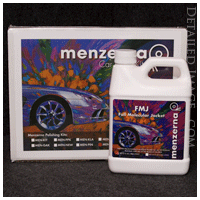
Menzerna Full Molecular Jacket (FMJ) is our best selling sealant. The ease of use for applying and removing this particular sealant is mind boggling. When you remove this product, very little effort is needed. Of all the products we’ve ever tested, this product remains on top for ease of removal. After removing this sealant, you’ll instantly notice the increased surface slickness Menzerna FMJ leaves behind on the paint. In conjunction with a just clayed surface prep and topping with Menzerna FMJ, it is tough to rival that combination for maximum surface slickness. Durability is expected to last between 3 – 6 months, but because of the ease of use, we recommend applying this product once a season to ensure year round protection on your vehicle.

For the month of September, Menzerna Full Molecular Jacket is on sale for 20% off. The 16oz kit is on sale for $31.99 (normally $39.99) and the 32oz bottle is on sale for $39.99 (normally $49.99)

For regular maintenance of Menzerna FMJ, consider following up your washes with Menzerna’s High Gloss Acrylic Shield. This product was specifically formulated to work on top of existing layers of Menzerna FMJ to restore surface slickness and enhance depth and gloss. HGAS also extends the durability of FMJ.

My Offers
Quantity Discounts - Buy More, Save More!
Big Discounts While Supplies Last - Clearance Items - Shop Now
Bulk Microfiber Deals
Free Stuff
Close overlay