Free Shipping over $199 w/coupon DIFree | 3,200+ Products | 98 Brands | 12,500+ Reviews | 2,200+ Detailing Articles
Close Menu
Clean ⋅ Shine ⋅ Protect
Cookies are disabled in your web browser. To shop with Detailed Image, please turn cookies on and then refresh the page.

Leather Care You May Not Think Of

November 1st, 2007

No one likes to see their leather fade, crack or stretch, yet this is an extremely common problem. As most people are aware, good leather care involves a regular routine of cleaning and conditioning. Cleaning your leather helps remove contaminates that become embedded in the leather and clog the leather’s pores. Conditioning helps replace proteins and other natural properties that can fade over time due to normal usage, UV rays, etc. These basic steps are essential elements to good leather care but there are other ways to care for your leather that are just as important.

The driver’s side bolster, or the part of the driver’s seat closest to where the driver enters and exits the vehicle, often shows the most wear and tear. This area is prone to stretching and cracking due in large part to the method by which the driver enters and exits the vehicle. Often times while entering the vehicle you will sit down on the edge closest to the door and slide into the middle of the seat. While this method is natural to most people, there are two basic problems with this technique. Most seats are slightly concave with the lowest point being in the middle of seat. Therefore when you sit on the edge you force the leather to flatten, which stretches and flexes the leather, especially on the outer edge. If you repeatedly stretch and flex the leather you may prematurely start to add permanent creases, cracks and stretch marks to the leather. The second problem is when you slide and twist your body to move from the outer edge to the middle of the seat. Your body’s downward force will generate plenty of friction to start to slowly wear away the top layer of your leather. This can lead to your leather looking worn and faded and this damage is generally permanent. These same exact problems happen in reverse when you’re exiting the vehicle. Most people twist and slide their body towards the outer edge of the seat and then exit the vehicle. To help prevent these kinds of problems try and reduce how much you slide and twist in your seat. Instead lift straight up and down when entering and exiting the vehicle. This simple step can be a tremendous help towards preserving your leather.

One step that should be apart of everybody’s routine is protecting your leather. Ultra Violet rays from the sun can dry out and fade your leather. Heat helps opens the pores of your leather, which allows proteins and other nourishing elements to evaporate more readily. Without these properties leather becomes less flexible which can lead to fading, cracking and stretch marks. After you have cleaned and conditioned your leather you can protect your leather with a product like the 303 Aerospace Protectant. Lightly mist the protectant on a microfiber towel outside of your vehicle, to avoid overspray, and wipe down the seats. Make sure you regularly protect areas that have prolonged exposure to the sun. A good protectant will also make it easier to remove contaminates and oils during future cleanings.

Here are some other areas of concern that you should be aware of to help care for your leather. Be careful that your seatbelt does not regularly rub against the leather. Always use safety first, but adjust the belt accordingly if it’s potentially damaging the leather. Be careful of what you and others wear in your vehicle. Some articles of clothing and jewelry can be sharp or blunt like buttons, rivets, and zippers that can potentially scratch or otherwise harm your leather. Human oils, lotions, make-up and contaminates that are commonly found on the human skin can prematurely dry leather. Avoid touching your leather excessively and wipe down any areas that regularly come in contact with human skin.

Try and observe any other habits you may have that may be harmful to your leather, and see what you can do to minimize them. Follow the tips listed above and regularly clean and condition your leather and you’ll have leather that always looks great.

How soon can I detail [or wash] my brand new vehicle?

October 21st, 2007

I see the question asked quite a bit, “When can I detail [or wash] my brand new car?” . The answer is simple, the sooner the better. Many people have the misconception that the paint has to cure so many days after receiving a new car before they apply a coat of sealant or wax. New vehicles typically undergo a process that bakes, or heats up, the painted shell during production. By the time this process is over and the vehicle reaches its destination, the paint has typically had enough time to fully cure.

When you get work done from a body shop, the paint typically needs between 30 – 120 days of cure time before you should apply your favorite sealant or wax.   This means you can still wash and dry, clay bar, polish and glaze your vehicle.  It is best to ask the place that performed the paint work exactly how long you should wait for the paint to cure.  Different shops use different products and techniques during the painting process which can vary the cure time.

Stoner Tarminator – Bug & Tar Remover

October 21st, 2007

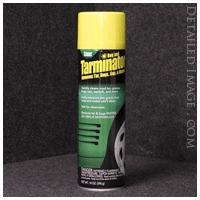
Stoner TarminatorDetailed Image is proud to announce a new product we have picked up from the makers of the popular Stoner Invisible Glass, Stoner Tarminator. Tarminator is an excellent product for dissolving , such as bug smear, tar, sap, and other stubborn road contamination. Simply spray this product onto your paint where the contamination resides and let it dwell for a minute or two. Quite often you’ll see the contamination dissolve right before your eyes. This product is best used before a wash as a pre-wash degreaser. This product is powerful so you will want to reapply your protection, whether a sealant or wax, after using Stoner Tarminator.

Circular vs Straight Line Hand Applications

October 5th, 2007

There seems to be a lot of confusion over what hand application method works best or is the safest (straight lines vs. circular motions). The major difference between applying products in a circular motion verse straight lines is your coverage. I feel a circular motion allows you to work in a product more evenly and hit areas at multiple angles for a more thorough application. This is especially important when polishing for best results. The same thing applies for a wax or sealant that you want to be applied to every microscopic peak and valley in the clear coat. The Porter Cable 7424 moves in an oscillating pattern which is basically a tight circular motion meant to replicate circular hand movements. This results in very good product breakdown and coverage for a thorough application.

Some people feel that a circular motion will create micro-scratches in a circular pattern in the clear coat. Therefore with that logic, they feel straight hand motions will only create straight micro-scratches that are less noticeable to an observer. If you are creating micro-scratches in the clear coat your problem lies in your prep work or products and tools used during the process, not your technique. If micro-scratches are being added you may be experiencing one or more of the following problems:

– You are using a contaminated applicator pad
– You are using a non-paint safe applicator pad
– You are using a contaminated removal towel
– You are using a non-paint safe towel
– You are applying a product over a contaminated area

    With any one of the above situations you can easily be grinding in contaminates in to the clear coat which can cause micro-scratches regardless of your technique. Additionally the same concept is true if the applicator or removal towel you are using is too coarse. Some common problems we see are people using an applicator pad or removal towel that has old and dry product (i.e. wax) in it or a large piece of contamination that’s abrasive. Contaminates and old product can become lodged in an otherwise good applicator or removal towel and make it a potentially dangerous tool. Contaminates left on the surface of your vehicle can also be very dangerous. To decrease the risk of grinding in contaminates make sure you do a thorough wash with a pre-wash degreaser and use a clay bar to deep clean the micro-ridges of the clear coat. When wiping an area that has contamination you may loosen the contamination or part of it. These contaminates can then be grinded in to the clear coat or become lodged in your applicator or removal towel. It’s very important to regularly inspect all of your towels, applicators, buffer pads, etc. for contamination that could be potentially dangerous and replace as needed.

    Differences between Porter Cable 7424 and generic buffers

    October 5th, 2007

    While each buffer is different I’ll point out some common differences between the Porter Cable 7424 and some of the “generic orbital buffers”. Some of these differences are subtle, but noticeable if you really want the best results. I’ll highlight some of the main differences and why they are important.

    One of the best things about a Porter Cable buffer is you can attach a velcro backing plate to it. The velcro backing plate allows you to use various pads, such as the Lake Country foam pads. Changing pads takes only takes a few seconds. The Lake Country Pads are clear coat safe designed to complete each step of the detailing process with maximum results. If you want to remove swirls and imperfections you can use a more aggressive pads or if you want to apply a wax there are nice soft pads, etc. These pads are particularly important for polishing to attain maximum results.

    Generic buffers typically use terry cloth bonnets that have several downsides. Some terry cloth is manufactured too firm and can potentially mar the paint. While doing the detail you most likely wouldn’t notice these micro scratches because if you are applying a wax, the wax is covering it up. However after detailing for years I’ve come to notice that some terry cloths can really harm the finish, especially as the bonnet becomes contaminated and worn down. Terry cloth is also very thin which means it can’t absorb contaminates that separate from clear coat while buffing as well as foam pads. These contaminates can grind into the clear coat, where as foam pads are better designed to absorb contaminates into its 1.25 inch thick pad. These pads are very durable so you can clean them and use them over and over again. Some generic buffers have a jerky orbital motion and far less OPMs (Orbits Per Minute), which is essential for effective polishing. The Porter Cable 7424 has a speed dial that allows you to change the power from 1 – 6 or from 2,500 to 6,000 OPM, while many competing buffers just have 1 or 2 speeds. Polishing is the step where you remove swirls, oxidation and really brighten the clear coat for maximum shine. The 3.7 amp motor is very powerful and does a great job of building consistent heat and pressure. Despite this powerful buffer it’s also very safe and has minimal risk of harming your paint. Many traditional orbital buffers require you to have two hands on it, which makes it very difficult to buff very low panels, corners, center of the roof and hood. The Porter Cable’s smooth motion and light weight (7lbs) make it very easy to maneuver around corners and near trim with one hand or two.

    One of my favorite parts about the Porter Cable 7424 is its reliability because I really feel like you get what you pay for and it’s backed with a one year warranty. This is a super durable machine that you will be detailing with for years to come.

    Differences between light, dark and metallic colored paints

    October 3rd, 2007

    Selecting the right color paint for a new vehicle or knowing more about your current color will help you understand your paint better. Darker colored paints will typically absorb more light and heat which gives off a deeper reflection then lighter colored paints. The depth and gloss of your paint is a major asset to achieving the maximum shine. Therefore when you complete a full detail on darker colored paint it will generally look better to most people. Conversely black paint also tends to show imperfections such as swirls and contamination build-ups much more than lighter colors. Some vehicles have flat paint while others have metallic flake added to the paint. The metallic flake makes the paint appear to have varying depth. In my opinion the metallic flake takes away from the overall depth and gloss but it helps hide imperfections.

    Flat black paint will typically give off the most gloss while metallic silver paint will hide imperfections the most. There is no one universal best color, only the color that works best for you. I recommend darker colored paints to those who enjoy caring for their paint and having that deep shine after a detail. Lighter colors are probably better for those who prefer low maintenance vehicles.

    Lake Country Pads for Porter Cable 7424 on Sale!

    October 1st, 2007

    For the month of October all Lake Country pads are on sale for just $7.99!  Purchase a pad as a complementary item to another product and instantly save another 5%, making the final price $7.59.

    Worn out and contaminated pads can hinder your results as well as potentially add imperfections to your paint.  It is good practice to clean your buffer pads every few panels or simply replace them with a fresh pad for maximum results.  Allowing the product to cake up will bog down your pad and minimize cutting ability if you are trying to remove imperfections.  Periodically cleaning your pads or swapping them out also means that the pads are easier to clean and you will extend the life of your pads.  Take advantage of this monthly sale and save today!

    How to use your buffer around trim and tight areas

    September 27th, 2007

    To ensure you don’t get any product on areas you don’t mean to you should tape off areas like the door handles, lights, trim, glass, emblems, grills, mirrors, bumpers, rubber seals, etc. We recommend taping off areas that can easily be stained and are hard to avoid. We use painter’s tape (usually 3M’s blue painters tape) that can be found at a local hardware store and it applies and removes very easy from the clear coat.

    Using the Porter Cable 7424 around trim and tight spaces takes time to master and you should only do what you feel comfortable with. If you feel a buffer may be dangerous to use around certain areas you should probably avoid using the buffer there. Areas you should be careful around are: trim, emblems, door handles, side view mirrors, windows, sunroof, grills, bumpers, spoilers, joints, lights, etc. Some of these areas may need to be completed with precision hand application. I typically use the Porter Cable 7424 on any area that I can easily buff without risking harm to the surrounding paint, trim, etc. If you feel comfortable holding the buffer at odd angles you may be able to detail more challenging areas like the bumpers, around trim, side view mirrors, etc. It’s okay to hold the buffer at angles as long as you don’t put too much pressure on the part of the pad touching the clear coat. Additionally, not using the supplied side handle for the PC may help you get into some tough to reach places like under the side view mirrors. For those tough to reach areas you may need to move the buffer at a very slow pace and lower the speed to gain more control. When in doubt, side with caution and don’t risk harming the vehicle.

    « Newer PostsOlder Posts »
    My Offers
    20 Off Brand Sale Gyeon CarPro  Griots Garage
    Free Stuff
    Big Discounts While Supplies Last - Clearance Items - Shop Now
    Quantity Discounts - Buy More, Save More!
    Close overlay